⚠️ Not financial advice: This post is for educational purposes only. I'm not a licensed financial advisor. Please do your own research and consult a professional before making any financial decisions. Full Disclaimer →
Here's the number that explains why so many people in their 20s and 30s feel stuck on housing: to afford the median-priced U.S. home in 2026, you need a household income of approximately $115,000. The median Gen Z income is $84,000. The average U.S. worker earns $64,505. That gap — $31,000 to $50,000 per year — is not a budgeting problem. It's a structural affordability problem, and pretending otherwise helps no one.
But "you can't afford it" is not the end of the conversation. In this post we're going to look at why the math looks the way it does, where it actually breaks your way (and it does in some places), and three real paths that people are using to move forward — not someday, but now.
The honest math: what "afford" actually means
The standard rule lenders use is that your housing costs — mortgage principal, interest, taxes, and insurance — shouldn't exceed 28% of your gross monthly income. That's called the front-end debt-to-income ratio, and most conventional lenders won't approve you if you're significantly over it.
Let's apply that to what it actually costs to buy the median U.S. home right now (as of April 2026, median existing-home price is $417,700, per the National Association of Realtors):
| Item | Amount |
|---|---|
| Median home price (NAR, April 2026) | $417,700 |
| Down payment (20%) | $83,540 |
| Loan amount | $334,160 |
| 30-year fixed rate (avg. 6.5%, as of May 2026 — Freddie Mac) | — |
| Monthly principal + interest | ~$2,112 |
| Property tax + insurance (est.) | ~$580/mo |
| Total monthly housing cost | ~$2,692 |
| Income required (28% rule) | ~$115,400/year |
If you put down less than 20%, add private mortgage insurance (PMI) — typically 0.5–1% of the loan per year, or another $140–$280/month. The required income goes up, not down.
Why did this happen?
The short version: mortgage rates roughly doubled between 2021 and 2023 — from under 3% to over 7% — which pushed monthly payments up dramatically even as home prices stayed stubbornly high. Inventory stayed low because homeowners who locked in 3% rates had no incentive to sell and take on a 7% mortgage somewhere else. Prices didn't fall the way they historically do when rates spike, because supply never increased enough to offset demand. As of 2026, rates have eased slightly but remain elevated, and prices in most markets haven't corrected. That's the jam we're in.
The plot twist: in 57% of U.S. counties, buying is cheaper than renting
Here's the part most housing coverage misses. According to The Mortgage Reports' 2026 analysis, it is now cheaper on a monthly basis to buy than to rent in 57.7% of U.S. counties. The reason this surprises people is that housing coverage is dominated by coastal markets where the math goes the other way entirely.
The geographic split is stark. In the Midwest and South — markets like Kansas City, Pittsburgh, St. Louis, Indianapolis, Cleveland, Columbus, Memphis, and Birmingham — home prices are moderate enough that a mortgage payment at current rates is actually competitive with (or lower than) local rents. On the coasts — Los Angeles, Seattle, New York, San Francisco, Boston, Miami — renting is significantly cheaper on a monthly basis, often by $1,000–$2,000 per month.
| Market type | Median home price (est.) | Monthly mortgage (20% down, 6.5%) | Typical rent (2BR) |
|---|---|---|---|
| Midwest/South mid-cost metro (e.g. Kansas City) | ~$240,000 | ~$1,215 | ~$1,400 |
| National median | $417,700 | ~$2,112 | ~$1,900 |
| High-cost coastal metro (e.g. Los Angeles) | ~$900,000 | ~$4,550 | ~$2,600 |
What this means in practice: If you live in a high-cost coastal metro, you are likely renting at a meaningful discount versus owning — and that monthly savings can be invested productively. If you live in or are open to moving to a mid-cost metro, the buy-vs-rent math may genuinely favor ownership. Location is doing almost all of the work here.
Three real paths forward
Given where the numbers sit, here are the three strategies that actually move the needle — not advice to "save more" or "wait for rates to drop."
Rent and invest the difference
If renting is significantly cheaper than buying in your market, treat the difference not as found money but as a wealth-building contribution. In Los Angeles, for example, renting a two-bedroom for $2,600 versus carrying a $4,700 mortgage leaves $2,100/month. Invested in a low-cost index fund at a historical average return of 7% annually, that compounds into real wealth faster than most people expect.
The key requirement: you have to actually invest the difference, not let it dissolve into lifestyle spending. Automate it the day rent is due so the decision is never in front of you.
Target a mid-cost metro
If homeownership is important to you and your income is in the $75,000–$110,000 range, the most direct path is targeting a market where the math works. This isn't a suggestion to move somewhere you hate — it's a framework for evaluating whether a relocation actually pencils out.
The three-question test: Does the local job market support your career at comparable or better compensation? Is the cost-of-living improvement large enough to materially change your savings rate? Is the lifestyle close enough to what you want? If yes to all three, the financial case can be compelling. Cities like Pittsburgh, Kansas City, Columbus, Indianapolis, and Raleigh consistently rank among the most accessible for buyers earning under $90,000 — with median home prices between $220,000–$300,000.
House hacking
House hacking means buying a small multi-unit property — a duplex, triplex, or property with a basement apartment — living in one unit, and renting out the others. Your tenants' rent offsets your mortgage, often dramatically. Done well, you can live for free or close to it while building equity as an owner.
This strategy requires more up-front capital and a willingness to be a landlord — you'll want to screen tenants carefully and budget for maintenance. But it's one of the most powerful first-purchase strategies available. For a deeper look at the landlord side of the equation, see our guide to real estate investing for beginners.
If you do want to buy: three levers that actually help
If you're set on buying in your current market, here are the three levers that can meaningfully move the numbers in your favor — no gimmicks, no waiting for a market crash.
Down payment assistance programs
Most states and many municipalities offer first-time homebuyer assistance — grants and forgivable loans that can cover part of your down payment. Our full guide to down payment assistance programs in 2026 breaks down how to find and qualify for them, and the HUD local homebuying programs directory is a good place to start. Some programs don't require you to be a first-time buyer at all — just someone who hasn't owned in the last three years.
Co-buying with a partner or family
Combining incomes is the most direct way to close the affordability gap. Two people each earning $75,000 — a joint $150,000 household income — suddenly qualify comfortably for a median-priced home. Co-buying with a sibling or parent is also increasingly common; a real estate attorney can structure it with a tenancy-in-common agreement that protects all parties.
Credit score optimization
The difference between a 680 and a 760 credit score can be 0.5–0.75 percentage points on your mortgage rate. On a $336,000 loan, that's roughly $100–$160/month — or $36,000–$58,000 over 30 years. Pull your free credit report, pay down revolving balances below 30% utilization, and address any errors at least 6 months before applying. While you're still renting, rent reporting can turn your on-time rent into positive credit history — often for free.
FHA loans (lower barrier to entry)
FHA loans allow down payments as low as 3.5% with a credit score of 580+. The trade-off is mandatory mortgage insurance for the life of the loan (or until you refinance). For buyers who have the income to support monthly payments but haven't been able to save a 20% down payment, FHA can be the path in — especially in lower-cost markets where home prices make the PMI cost manageable.
The bottom line
Housing affordability is genuinely harder for 25–38 year olds today than it was for previous generations at the same age. That's not a perception problem — the math confirms it. But "the math is hard" is different from "there's nothing to do." The rent-and-invest strategy, the mid-cost metro calculation, and house hacking are all real, working strategies that people are using right now. The worst move is waiting passively for conditions to change in your favor while doing nothing with the financial position you're in.
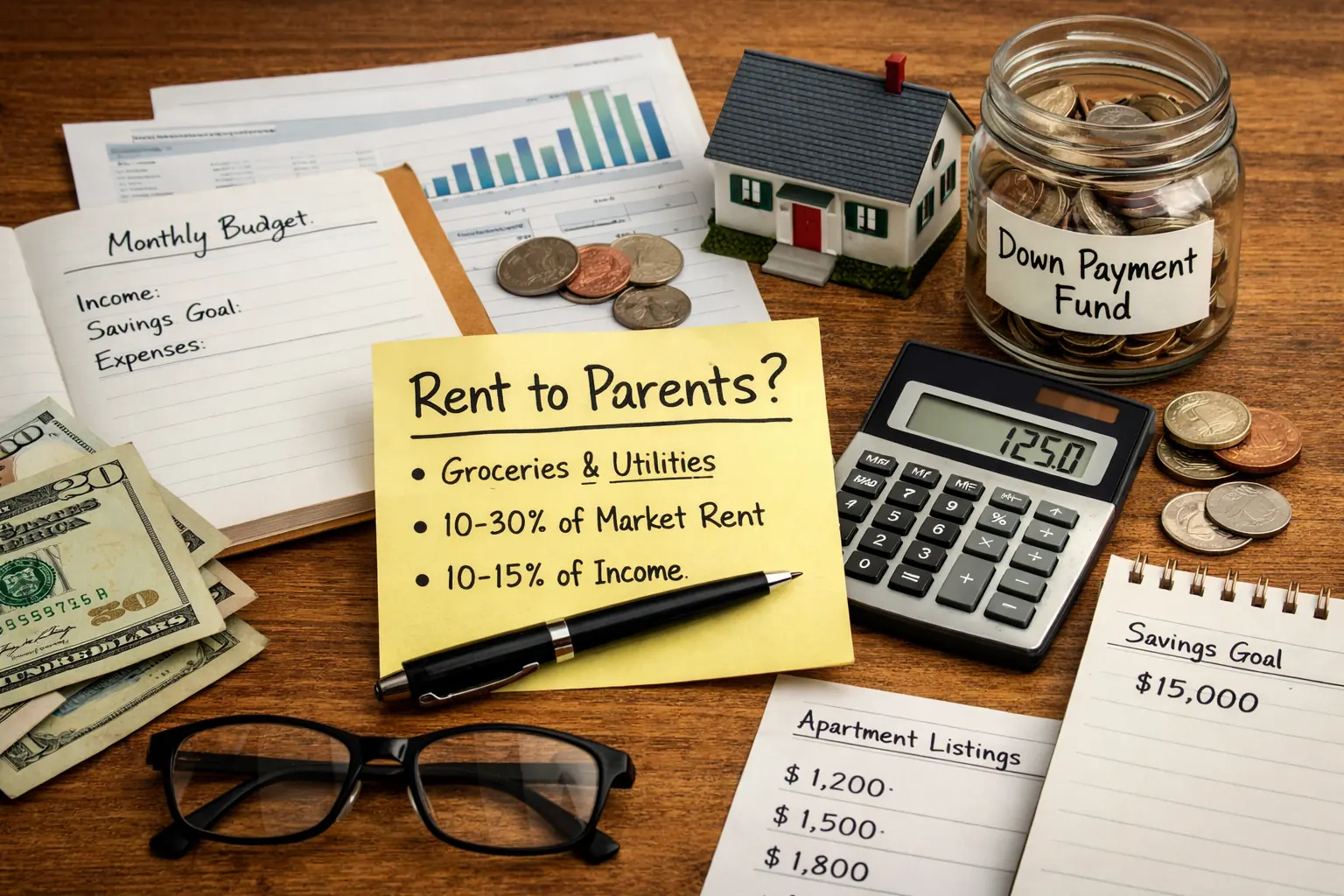
Pick the path that fits your income, your career flexibility, and your appetite for being a landlord or a mover. Run the actual numbers for your specific market — not national averages — and make a decision based on what you see, not what the headlines say. And if the fastest route to your down payment runs through your childhood bedroom, you're in good company — here's how to structure moving back in with your parents (and what to pay them) so it actually works.

Rally's take
Before you decide whether to buy or keep renting, calculate your actual local price-to-rent ratio: divide the median home price in your area by the annual cost to rent a comparable unit. A ratio above 20 generally favors renting and investing the difference — and if renting wins for now, negotiating your next rent renewal is the fastest way to widen that gap. Below 15 generally favors buying. Between 15–20, it's a close call that comes down to your timeline and how much you value stability. Your ZIP code matters more than the national average ever will.
Worth knowing where those mortgage rates come from, too: they are priced off Treasury yields, which federal borrowing pushes upward. Our guide to the $40 trillion national debt and your money traces that line and prices out what a single percentage point costs on a $400,000 loan.
Frequently asked questions
What income do you need to afford a house in 2026?
According to The Mortgage Reports, you need a household income of approximately $118,530 to afford the median-priced U.S. home in 2026, assuming a 20% down payment and the standard 28% housing-cost-to-income rule. Most single-income households earning the U.S. average of $64,505 fall well short of that threshold.
Is it cheaper to rent or buy a home in 2026?
It depends heavily on where you live. According to The Mortgage Reports, buying is now cheaper than renting in 57.7% of U.S. counties — primarily across the Midwest and South. On the coasts and in major metros like Los Angeles and New York, renting remains significantly cheaper on a monthly basis, often by $1,000–$2,000 per month.
What is house hacking and how does it help with housing affordability?
House hacking means purchasing a multi-unit property, living in one unit, and renting out the others. Your tenants' rent offsets your mortgage payment, dramatically reducing your effective housing cost. A well-executed house hack can let you live for under $500/month while building equity — one of the most powerful first-purchase strategies available for buyers with limited cash flow.
Should I rent and invest instead of buying a house?
In high-cost markets where renting is significantly cheaper than buying, investing the monthly savings in a low-cost index fund can build substantial wealth over time. If renting saves you $1,500/month, investing that consistently at a 7% average annual return grows to roughly $107,000 in five years and $260,000 in ten. The strategy only works, however, if you actually invest the difference rather than spending it.
What are the best cities for first-time home buyers in 2026?
Mid-cost metros in the Midwest and South offer the best affordability for first-time buyers in 2026. Cities like Pittsburgh, St. Louis, Cleveland, Detroit, Kansas City, Columbus, and Indianapolis consistently rank among the most accessible markets, with median home prices well below the national average and local job markets that increasingly support remote workers.