🔗 Heads up: Some links in this post are referral links. If you apply or sign up through them, I may receive a commission — at no extra cost to you. I only recommend products I genuinely believe in.
⚠️ Not financial advice: This post is for educational purposes only. I'm not a licensed financial advisor. Please do your own research and consult a professional before making any financial decisions. Fees, prices and card benefits are current as of August 2026 and change often.
🤖 This article was produced with AI assistance and reviewed by our editorial team.
Food delivery costs about 80% more than picking up the same meal. A LendingTree analysis of five national chains across the ten largest U.S. metros found delivery ran 79.5% higher than pickup — an average of $21.00 delivered versus $11.71 picked up. DoorDash was the most expensive of the three platforms tested, at an 83.3% markup.
The reason that number surprises people is that the delivery fee — the one line everybody blames — is nowhere near the biggest piece. Most of the gap is hidden somewhere you never see it.
Here's the whole thing, itemized.
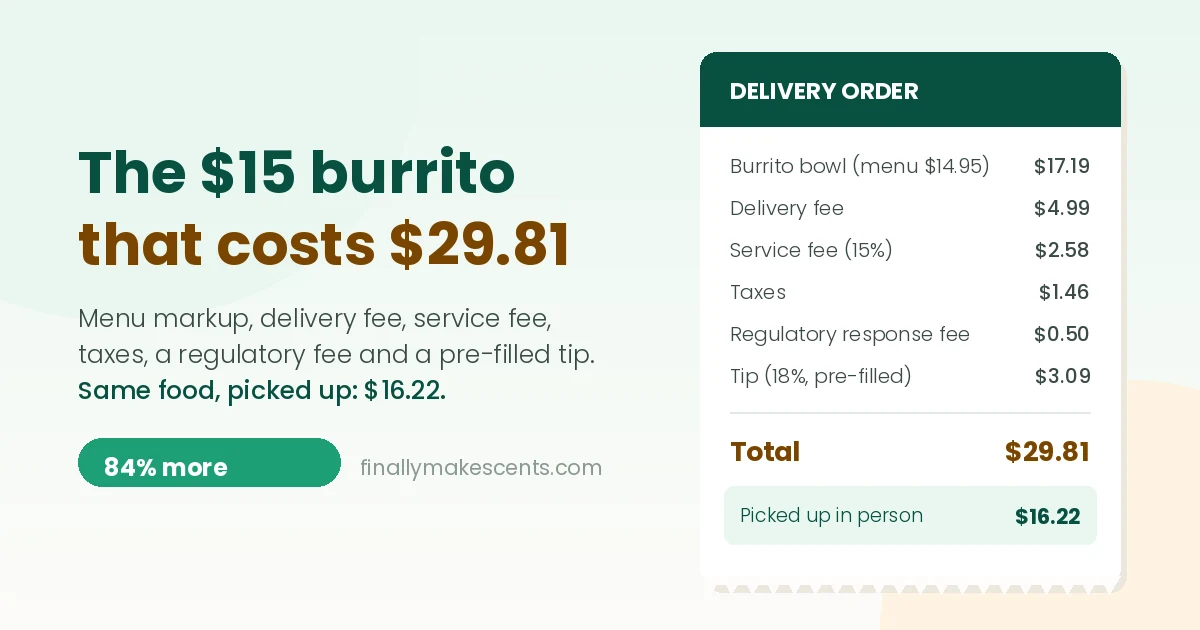
The $15 Burrito That Costs $29.81
Take a burrito bowl that costs $14.95 on the board inside the restaurant. Here is that same bowl, ordered for delivery, with typical 2026 fee levels:
| Line item | What you pay |
|---|---|
| Burrito bowl (in-store price: $14.95) | $17.19 |
| Delivery fee | $4.99 |
| Service fee (15% of subtotal) | $2.58 |
| Sales tax | $1.46 |
| Regulatory response fee | $0.50 |
| Tip (18%, pre-filled) | $3.09 |
| Total | $29.81 |
| The same food, picked up yourself | $16.22 |
That's $13.59 extra — 84% more — which lands almost exactly on the 83.3% DoorDash markup LendingTree measured.
Now look at where the money actually went. The delivery fee was $4.99, about 37% of the gap. The single largest chunk is that first line: $2.24 of pure menu markup you never saw, plus the tax and tip that get calculated on top of the inflated number. You tipped 18% on a price that was already padded.

Rally's two cents: "I have watched this human negotiate a phone plan for forty-five minutes to save four dollars a month. Then a burrito arrived at the door for twice its price and he said 'worth it' before he even opened the bag. I am not judging. I would also pay double to have food brought directly to me. But let's at least be honest that it's a choice and not a delivery fee."
The Markup You Can't See
Here's why that first line is inflated, and why it isn't really the restaurant's fault.
Delivery apps charge restaurants a commission — a cut of every order that comes through the platform. According to the Independent Restaurant Coalition, those commissions run 15% to 30% of total order value. Meanwhile, a typical restaurant operates on a net profit margin of 3% to 5%.
Read those two numbers next to each other and the math is brutal: the commission is several times larger than the entire profit on the meal. A restaurant that charges its normal price on DoorDash isn't making less money on that order — it's losing money on it.
So most of them raise their app prices. Industry estimates put typical delivery-app menu markups at 5% to 25% above in-store pricing, with big chains clustering around 10% to 20% and independents ranging from 0% — absorbing the whole hit — to 25% and up.
Why this matters more than the fee lines. Fees are disclosed. You can see them, argue with them, and a subscription can waive them. The menu markup is baked into the item price, appears nowhere on your receipt, and no membership on earth removes it. It's also the base that your tax and your tip are calculated from — so it multiplies.
Regulators Are Circling. Don't Wait for Them.
On April 16, 2026, the Federal Trade Commission published an advance notice of proposed rulemaking on unfair or deceptive fees in online food delivery services. The comment period closed May 18, 2026, drawing more than 200 submissions, including from Consumer Reports and the Consumer Federation of America. Separately, New York City has moved on delivery fee caps of its own.
Two reasons not to plan around it. First, timing: an advance notice is the earliest possible stage, and the FTC's comparable junk-fee rule for tickets and hotels took roughly two and a half years to reach implementation.
Second, and more important: fee-transparency rules make companies show you the fee. They don't make it smaller. We watched this play out with hotels — as we covered in how to actually stop paying resort fees, the fees didn't vanish, they just moved into the total. Expect the same here.
Four Ways to Actually Pay Less
1. Order pickup — but order it direct
This is the single biggest lever, and there's a version of it most people get wrong. Choosing "pickup" inside the DoorDash app kills the delivery fee and usually the service fee — but you're still paying the marked-up app menu price. Ordering from the restaurant's own website, its own app, or the phone gets you the real menu price with no markup and no fees at all.
On our example order, app pickup saves you about $8. Direct pickup saves you $13.59.
2. Do the subscription math honestly
DashPass runs $9.99 a month or $96 a year as of August 2026 ($4.99 a month for verified students), and waives delivery fees on eligible restaurant orders over $12 while reducing service fees. Uber One is priced the same at $9.99 a month.
The break-even is roughly two to three delivery orders a month. Above that, it pays. Below that, you're paying $120 a year for the privilege of ordering delivery — and remember, it does nothing about the menu markup, which was the biggest line on our receipt. This is the same trap we ran the numbers on in is a Costco membership worth it for one person: a membership only saves money at a volume you actually hit.
3. Kill the three avoidable lines
Three charges on a typical order are partly or entirely within your control:
The small order fee ($2–$3 on orders below a $10–$12 minimum) is pure waste — a penalty for ordering less. Either add something you'll actually eat tomorrow, or don't order. Priority delivery is an upsell, frequently pre-selected, and buys you a few minutes.
The pre-filled tip deserves a hard look — not to stiff your driver, who is the one person here genuinely earning it, but because the default is a percentage of the inflated menu price. A flat dollar amount that reflects the actual work is both fairer to the driver and immune to the markup.
4. Let a card or a gift card absorb part of it
If you're going to order delivery regardless, at least don't pay full retail for it. The Chase Sapphire Preferred comes with complimentary DashPass — a $96-a-year value on its own if you'd otherwise buy it — plus a $10 monthly credit on DoorDash. Read the fine print on that credit, though: it applies to non-restaurant orders only (grocery, convenience, retail, DashMart), covers the subtotal but not fees, taxes or tip, is limited to one order a month, and doesn't roll over. So it's a $120-a-year grocery credit, not a burrito credit. Useful — just not for the thing in this article's title. We break the rest of the card down in our Chase Sapphire Preferred review.
The other angle is buying your delivery dollars at a discount. Costco has repeatedly run Uber eGift cards at around 20% off — $100 in face value for $79.99 — and Uber confirms that gift card credit works for Uber Eats orders, not just rides. That's a real 20% off the entire bill, markup included, which no membership or card credit manages. The catch is that Costco pulls and re-stocks this deal unpredictably, so treat it as an opportunistic buy rather than a plan.
The Habit That Beats All Four Combined
Every tactic above shaves a few dollars off an order. Frequency is the whole ballgame. LendingTree found nearly 4 in 10 Americans order delivery at least once a week, and 24% order multiple times a week. At our example order size, dropping from three deliveries a week to one saves roughly $3,100 a year — several times more than every fee tactic in this post stacked together.
The move isn't to quit. It's to give delivery a number. Decide what delivery is worth to you per month — $60, $100, whatever's honest — and treat that as the budget line. Once it's a named amount you chose, the $29.81 stops feeling like a fee you got tricked into and starts feeling like what it is: a convenience you bought on purpose. That's the same logic behind joy-based budgeting — you protect the spending you actually love by making it deliberate, and you cut the autopilot version. And if the real appeal was the meal rather than the couch, dining out without the guilt covers getting more out of the same money.
Delivery is a genuinely good deal on a bad night. It's a terrible deal as a default. The receipt is the same either way — what changes is whether you decided to pay it.
Frequently Asked Questions
Is it cheaper to order pickup on the app or directly from the restaurant?
Directly from the restaurant, almost always. Selecting pickup inside a delivery app removes the delivery fee and usually the service fee, but you're still paying the inflated app menu price — typically 5% to 25% above what the restaurant charges in person. Ordering from the restaurant's own site or phone line gets you the real price with no markup at all.
Is DashPass worth it in 2026?
DashPass costs $9.99 a month or $96 a year as of August 2026, and waives delivery fees on eligible restaurant orders over $12 while lowering service fees. It breaks even at roughly two to three delivery orders a month. Below that it's a loss — and it never touches the menu markup, which is usually the largest hidden cost on the receipt.
Why is the menu price higher on DoorDash than inside the restaurant?
Delivery apps charge restaurants commissions of roughly 15% to 30% of order value, while restaurants typically run 3% to 5% net profit margins. Because the commission is larger than the entire profit on the meal, most restaurants raise their app prices to cover it — commonly by 5% to 25%. It's built into the item price, so it never shows up as a line item.
Will the FTC rule make delivery fees go away?
Not soon, and probably not entirely. The FTC issued an advance notice of proposed rulemaking in April 2026 and comments closed that May, but no proposed rule has been published. The comparable junk-fee rule for tickets and hotels took about two and a half years from advance notice to implementation — and transparency rules generally require fees to be disclosed, not eliminated.