🔗 Heads up: Some links in this post are referral links. If you apply or sign up through them, I may receive a commission — at no extra cost to you. I only recommend products I genuinely believe in.
⚠️ Not financial advice: This post is for educational purposes only. I'm not a licensed financial advisor. Please do your own research and consult a professional before making any financial decisions. Full Disclaimer →
🤖 This article was produced with AI assistance and reviewed by our editorial team.
Somewhere between the 48-pack of toilet paper and the 3-pound tub of spinach, every single person has asked the same question: is any of this actually for me?
The conventional wisdom says Costco is for big families with big garages and bigger freezers. The "is Costco worth it" articles mostly agree, because they're all quietly written for a family of four. But conventional wisdom isn't math — and when you actually run the numbers for a household of one, the answer is more interesting than "no." Short version: a Costco membership is usually worth it for one person if you drive regularly, or if you can shift roughly $30–$40 a month of spending you already do to the warehouse. Either lever alone clears the $65 annual fee.
So let's run it: what the membership costs, exactly how much you'd need to save to break even, the two levers that decide it (one of them is your gas tank), and where bulk buying quietly backfires on solo households. And the gas lever is especially loud this month: with the national average back above $4 a gallon in late July 2026 on renewed Iran-related supply shocks, Costco's fuel discount is doing more work than it has in a while. By the end you'll have a one-line rule you can apply in about ten seconds.
What a membership actually costs (and the freebie most singles miss)
Costco has two consumer tiers, and as of July 2026 they cost:
Gold Star — $65 a year. Full warehouse access, gas station access, Costco.com at member prices. That works out to $5.42 a month — the number every calculation below has to beat.
Executive — $130 a year. Everything above, plus a 2% annual reward on qualified purchases (capped at $1,250 per year), early shopping hours, and a monthly $10 credit on Costco Same-Day/Instacart orders of $150 or more. Spoiler for solo shoppers: the 2% reward needs about $3,250 a year of Costco spending — roughly $271 a month — just to cover the $65 upgrade. Most one-person households aren't near that. Start with Gold Star; Costco will happily upgrade you later if your spending justifies it.
Now the part singles routinely overlook: every membership includes a free Household Card for anyone over 18 living at your address — and Costco doesn't care whether that's a spouse or the roommate you found on Facebook Marketplace. Split a Gold Star with a roommate and you're each in for $32.50 a year. Every break-even number in this post just got cut in half. Living solo-solo, no roommate? The math still works — it just has to clear the full $65.
The break-even math for one person
Break-even is simple: the membership pays for itself when (what you'd have paid elsewhere) minus (what you paid at Costco) exceeds $65 a year. The honest way to run that is to only count spending you'd be doing anyway — shifted to Costco, not invented for it. A "deal" on a 6-pack of hoodies you didn't need is not savings; it's the opposite.
Say you shift $150 a month of existing spending — pantry staples, paper goods, cleaning supplies, personal care, protein for the freezer — and Costco's pricing saves you a conservative 15% versus where you currently buy (you can verify your own gap in one trip by comparing unit prices — that's price per ounce or per count, the small number on the shelf tag). That's $22.50 a month in savings, or $270 a year against a $65 fee. Even at a stingier 10% gap, you clear $180 a year. The fee stops mattering surprisingly fast.
| If you shift this much monthly spend | Savings at 10% | Savings at 15% | Beats the $65 fee? |
|---|---|---|---|
| $50/month | $60/yr | $90/yr | Only at 15%+ — borderline |
| $100/month | $120/yr | $180/yr | Yes |
| $150/month | $180/yr | $270/yr | Yes — comfortably |
| $250/month | $300/yr | $450/yr | Yes — consider Executive |
Notice what that table is really saying: for a single person, the membership question is not "is Costco cheap?" (it is) but "can I realistically shift $30–$40+ a month of my existing spending there?" That's the first of the two levers. The second one lives in your driveway.
Gas: the stealth membership-payer
If you drive, there's a real chance the membership pays for itself before you buy a single grocery. Costco gas typically runs 10–30 cents per gallon below nearby stations, with around 20 cents being the commonly cited middle, per U.S. News' 2026 analysis of Costco fuel pricing.
And right now, this lever matters more than usual. As of late July 2026, the U.S. national average has climbed to about $4.09 a gallon — up roughly 15 cents in a single week — as renewed conflict involving Iran and disruptions around the Strait of Hormuz push crude oil back toward $100 a barrel (AAA, July 2026). When pump prices spike like this, two things shift for a solo Costco shopper: every fill-up takes a bigger bite out of your budget, so the membership fee gets recovered faster in real dollars; and because Costco runs its fuel as a low-margin loyalty draw, the gap to nearby branded stations tends to hold — or widen — rather than shrink. The cents-per-gallon math below doesn't change, but at $4-plus gas, clearing a $65 fee at the pump has rarely been easier to justify. (Gas prices are moving fast right now — check your local Costco vs. nearby stations for the current gap.)
The average American driver covers roughly 13,500 miles a year. At 25 mpg, that's about 540 gallons. Run the range:
540 gallons × 20¢ saved = $108 a year. At 30¢, it's $162. Either way, gas alone clears the $65 Gold Star fee — every grocery saving after that is pure upside. Even a lighter driver at 8,000 miles a year saves roughly $64–$96, essentially covering the fee at the pump.
This is the single biggest variable in the whole decision. A single person who drives past a Costco on their commute has a membership that pays for itself on autopilot. A single person in a walkable city with no car loses this lever entirely — and needs the grocery math above to do all the work. If you want to squeeze the pump even harder, we broke down how to stack station strategy, apps, and the right card in how to pay less every time you fill up.
The food-waste tax (where bulk buying backfires)
Now the honest part — the reason the skeptics aren't wrong, just incomplete. The USDA estimates that 30–40% of the U.S. food supply goes to waste, and research on household food waste consistently finds that one- and two-person households waste the most food per capita. The reason is structural: a family of four finishes the 3-pound tub of spinach; a household of one watches it liquefy on day six.
Every dollar of "savings" on food you throw away is a dollar lost at a worse price than retail — you paid less per ounce for ounces that went in the trash. For a single person, this is the entire game: Costco is a warehouse of incredible unit prices on things that keep, and a trap on things that don't. Which is why the buy/skip list below matters more for you than for any family.

Rally's take
"For the record, the 40-pound bag of dog food is the one bulk purchase in this house with a designated finisher. I have never once let kibble expire. The 3-pound spinach tub, though? I've watched three of those turn to soup from this very spot. Buy like someone's actually going to eat it — that's the whole trick." — Rally, head of quality control, freezer division
What to buy (and skip) as a solo shopper
✅ Buy — keeps, freezes, or gets used daily
- Pantry & paper: rice, pasta, olive oil, coffee, canned goods, toilet paper, paper towels, laundry detergent — unit prices are excellent and nothing expires on you.
- The freezer aisle: frozen fruit, vegetables, fish, and chicken portion out perfectly for one. The freezer is a single person's best Costco ally.
- Protein you portion yourself: buy the big pack, split it into freezer bags the day you get home. Ten minutes of work, restaurant-week savings.
- The $4.99 rotisserie chicken: unchanged since 1994, still one of the best food deals in America — and one bird is 3–4 solo meals (tacos, salad, soup, sandwiches).
- Personal care & pharmacy: toothpaste, contacts, OTC meds; Kirkland versions of name brands are a reliable value.
❌ Skip — the per-capita waste traps
- Giant fresh produce: the 3-lb spinach tub, the flat of berries, the 10-lb potato bag. Unless you meal prep religiously, this is compost at a discount.
- Bulk dairy & bread: two dozen eggs might work; two loaves of bread and a quart of half-and-half usually don't.
- Condiment vats: a gallon of mayonnaise is a multi-year relationship. Be sure you're ready.
- Impulse aisles: the $12.99 blanket and the 6-pack of anything you didn't come for. The savings math only counts spending you were doing anyway.
One habit ties this together: shop Costco monthly for the keepers, and keep a normal grocery store in the rotation for fresh food in single-person quantities. Costco replaces part of your shopping, not all of it. Pair it with the coupon-and-cash-back stack from how to cut your grocery bill without buying less and the two stores stop competing and start compounding.
The escape hatches (if you're still not sure)
The membership is genuinely risk-free. Costco's satisfaction guarantee means it will refund your membership fee in full if you cancel at any time. Worst case, you try it for six months, do your own math, and walk away whole. Very few $65 financial experiments come with an undo button; this one does.
You can also sample without joining. Non-members can use the pharmacy and get an eye exam from the independent optometrist, shop with a Costco Shop Card (a member has to buy it — membership-splitting friends, take note), order on Costco.com with a 5% surcharge, or get delivery via Instacart at marked-up prices. Those last two quietly answer the value question, by the way: paying the surcharge or markup on more than a handful of orders a year costs more than just buying the membership.
And if you do join, put the membership fee on the right card and treat the whole experiment like the other items on our 1-hour money hit list — a one-time setup that quietly pays you back all year.
The verdict: a one-line decision rule
Join if either is true: ① you drive enough to buy gas a few times a month near a Costco, or ② you can shift roughly $30–$40+ a month of spending you already do (pantry, paper, freezer, personal care) to the warehouse. Both true? It's not close — join, and reassess Executive once you're spending $271+/month. Neither true — no car, small kitchen, mostly-fresh diet? Skip it without guilt, or split a Household Card with a roommate at $32.50 each and let the bar drop to almost nothing.
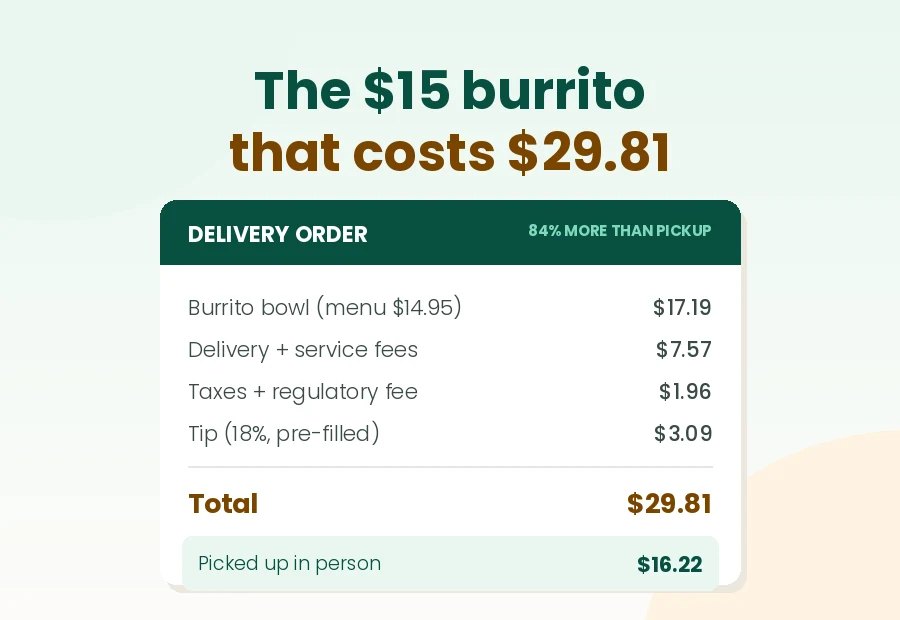
The family-of-four framing was always the wrong test. Costco for one person isn't about eating your way through pallets — it's about gas, keepers, and the freezer. The same break-even logic applies to any subscription that promises to save you money — we ran it on delivery apps in what you actually pay for a $15 burrito on DoorDash. Run your own two-lever check this week; if you clear either bar, that $65 might be the most boring, reliable return your budget produces all year.
Frequently asked questions
Is a Costco membership worth it for a single person?
Usually yes, if either of two things is true: you drive regularly (Costco gas typically runs 10–30¢ per gallon below nearby stations, which alone can cover the $65 fee), or you can shift roughly $30–$40 a month of existing spending — pantry staples, paper goods, freezer items, personal care — to Costco. If you don't drive and mostly buy fresh food in small quantities, the math gets much weaker.
Can you shop at Costco without a membership?
Partly. Non-members can use the pharmacy and book an eye exam with the independent optometrist, shop with a Costco Shop Card (purchased by a member), order on Costco.com with a 5% surcharge, or order via Instacart at marked-up prices. The warehouse floor, gas station, and member pricing all require a membership.
Is the Executive membership worth it for one person?
Rarely. The Executive upgrade costs an extra $65 a year and pays a 2% annual reward on qualified purchases, so you'd need to spend about $3,250 a year (~$271/month) at Costco just to cover the upgrade cost. Most single-person households don't. Start with Gold Star at $65 and upgrade only if your actual 12-month spending justifies it.
Can I share a Costco membership with a roommate?
Yes. Every membership includes one free Household Card for anyone over 18 at your address — roommates included. Split a Gold Star membership and you each pay $32.50 a year for full member access, which cuts the break-even hurdle in half.
What credit cards does Costco accept?
U.S. warehouses and gas stations accept only Visa credit cards — plus debit cards from any network, cash, and Costco Shop Cards. If your main rewards card is a Visa, like the Capital One Venture X, you're set at the register; Mastercard and Amex credit cards will be declined in-store.