⚠️ Not financial advice: This post is for educational purposes only. I'm not a licensed financial advisor. Please do your own research and consult a professional before making any financial decisions.
Between inflation and ongoing global instability, gas prices have stayed stubbornly high. The national average has hovered well above what most households budgeted for, and for anyone commuting, running errands, or just living their life — it adds up fast. The average American buys roughly 500 gallons of gas a year. At current prices, even a 30-cent-per-gallon reduction saves you $150 annually. Stack a few strategies together, and you can do significantly better than that.
The good news: there are proven ways to pay meaningfully less at the pump. The key is understanding that two main strategies exist, they don't fully combine with each other, but both allow you to layer on additional savings on top. Here's how to think about it.
Strategy 1: The Warehouse Club Route
Warehouse clubs like Costco and Sam's Club run their own gas stations — and they price fuel aggressively low on purpose. Because their business model runs on membership fees rather than product margins, they can afford to sell gas at near-cost. The result: Costco gas typically runs $0.20–$0.40 per gallon cheaper than what you'd pay at a Chevron or Shell down the street.
On 500 gallons a year, that's $100–$200 in savings from the base price alone — before you've added a single layer on top. If you're already a Costco or Sam's Club member for the grocery savings, the gas station is essentially a bonus benefit you may be underusing. Not a member yet — or flying solo? We ran the full membership break-even for a household of one in is a Costco membership worth it for one person.
Real example: If regular gas at Chevron is $4.60/gallon and Costco is $4.22, that's $0.38 saved per gallon. Fill up a 15-gallon tank and you've saved $5.70 in one stop. Do that once a week and you're looking at $296 per year — just from switching where you fill up.
Layer on: The Costco Anywhere Visa
The Costco Anywhere Visa (issued by Citi) earns 4% cash back on gas purchases worldwide — including at Costco's own pumps — up to $7,000 in gas spending per year. There's no additional annual fee beyond your Costco membership. At $4.22/gallon, 4% back equals about $0.17 per gallon on top of the already-discounted price. Combined, you're now effectively paying closer to $4.05 per gallon on gas that listed at $4.60 down the street.
Strategy 2: The Grocery Rewards Route
If a warehouse club isn't convenient for you, major grocery chains have built surprisingly powerful fuel savings programs. The idea is simple: earn points when you grocery shop, then redeem them as cents-off-per-gallon at partner gas stations. It turns your weekly grocery run into a fuel discount you accumulate automatically.
Ralph's / Kroger → Shell
Ralph's (part of the Kroger family) has partnered with Shell to offer fuel points redeemable at Shell stations. You earn 1 fuel point for every $1 spent at Ralph's — and every 100 points knocks $0.10 off per gallon, valid on up to 35 gallons per fill-up. Points can be redeemed in 100-point increments, so a $100 grocery week earns you $0.10/gallon off your next fill.
The best-kept secret in this program: buying gift cards at Kroger/Ralph's earns 2X fuel points. If you're going to spend money at a restaurant, Amazon, or a retailer anyway, buying the gift card at Ralph's first doubles your fuel point earn rate. A $50 Amazon gift card becomes 100 fuel points — instantly $0.10/gallon off at Shell, on top of whatever else you've earned that month.
Safeway → Chevron
Safeway runs a similar program, with points redeemable at Chevron stations. Every $1 spent at Safeway (in the grocery and pharmacy sections) earns 1 point, and 100 points translates to $0.10 off per gallon. The mechanics are nearly identical to the Kroger/Shell setup — it just depends on which grocery chain is closest to you.
Pro tip: These programs have monthly expiration windows — points generally must be used by the end of the following calendar month. Set a reminder to check your balance before it resets, especially in months where you've stacked gift card purchases.
Layer on: A Gas-Optimized Credit Card
You can't use the Costco Visa at Shell or Chevron at the same rate, but there are excellent cards that earn strong rewards at any gas station. The Citi Custom Cash earns 5% back on your top spend category each month — if gas is where you spend most, that 5% applies automatically, no category activation required. The PenFed Platinum Rewards Visa earns 5 points per dollar at the pump as well. Either one stacks cleanly on top of your grocery fuel points.
Strategy 3: The Apps That Stack on the Grocery Route
One important distinction: cash back apps like Upside and GasBuddy do not work at Costco or Sam's Club gas stations. Those are closed ecosystems — no third-party app partnerships, no external offers. If you're on the warehouse club route, your stack stops at two layers (price discount + credit card). But if you're on the grocery rewards route filling up at Shell, Chevron, or BP, you can add a third layer with these apps for meaningful additional savings.
Upside
Upside offers 5–25¢ cash back per gallon at thousands of stations nationwide. You claim an offer in the app, fill up, snap a photo of your receipt, and the cash posts to your account — withdrawable via PayPal, bank transfer, or gift card once you hit $1. It works at many major chains including Shell, BP, Exxon, and independent stations. In 2026, Upside has expanded coverage significantly and is the strongest pure cash back option at the pump.
GasBuddy
GasBuddy is best used as a price discovery tool — it crowd-sources real-time gas prices from drivers nearby, so you can spot the cheapest station on your route before you leave. The GasBuddy Pay card adds direct pump discounts (typically $0.05–$0.25/gallon) by paying directly from your checking account. Worth noting: the Pay card replaces your credit card at that transaction, so pair it strategically — use it only when the pump discount exceeds what your credit card would earn back.
Shell Rewards / ExxonMobil Rewards+
Both Shell and ExxonMobil run their own loyalty apps that award cents-off-per-gallon just for filling up at their stations regularly. Shell Rewards gives points on every fill that redeem as fuel discounts. ExxonMobil Rewards+ similarly accumulates points redeemable at the pump. If you're already gravitating toward these brands via a grocery rewards program, downloading the station's own app and scanning it at every visit layers on another small but free savings stream.
Putting It All Together
Here's how the two stacks actually compare on a typical 15-gallon fill-up, assuming a $4.60 street price at a traditional station. The warehouse club route is simpler — just two layers — but the grocery route can actually edge ahead once you add apps on top.
| Layer | Warehouse Club Stack | Grocery Rewards Stack |
|---|---|---|
| Base price advantage | −$0.35/gal (Costco price) | −$0.30/gal (100 pts redeemed) |
| Credit card cash back | −$0.17/gal (Costco Visa 4%) | −$0.23/gal (Citi Custom Cash 5%) |
| Upside app cash back | Not available at warehouse clubs | −$0.10/gal (avg offer) |
| Total savings per gallon | ~$0.52/gal | ~$0.63/gal |
| Savings on a 15-gal fill-up | ~$7.80 | ~$9.45 |
At once a week, the warehouse club stack saves roughly $405/year and the grocery route saves roughly $490/year compared to pulling up to the nearest Chevron with a no-rewards debit card. Both are meaningful — the right choice simply depends on where you already shop and which gas station is most convenient on your route.
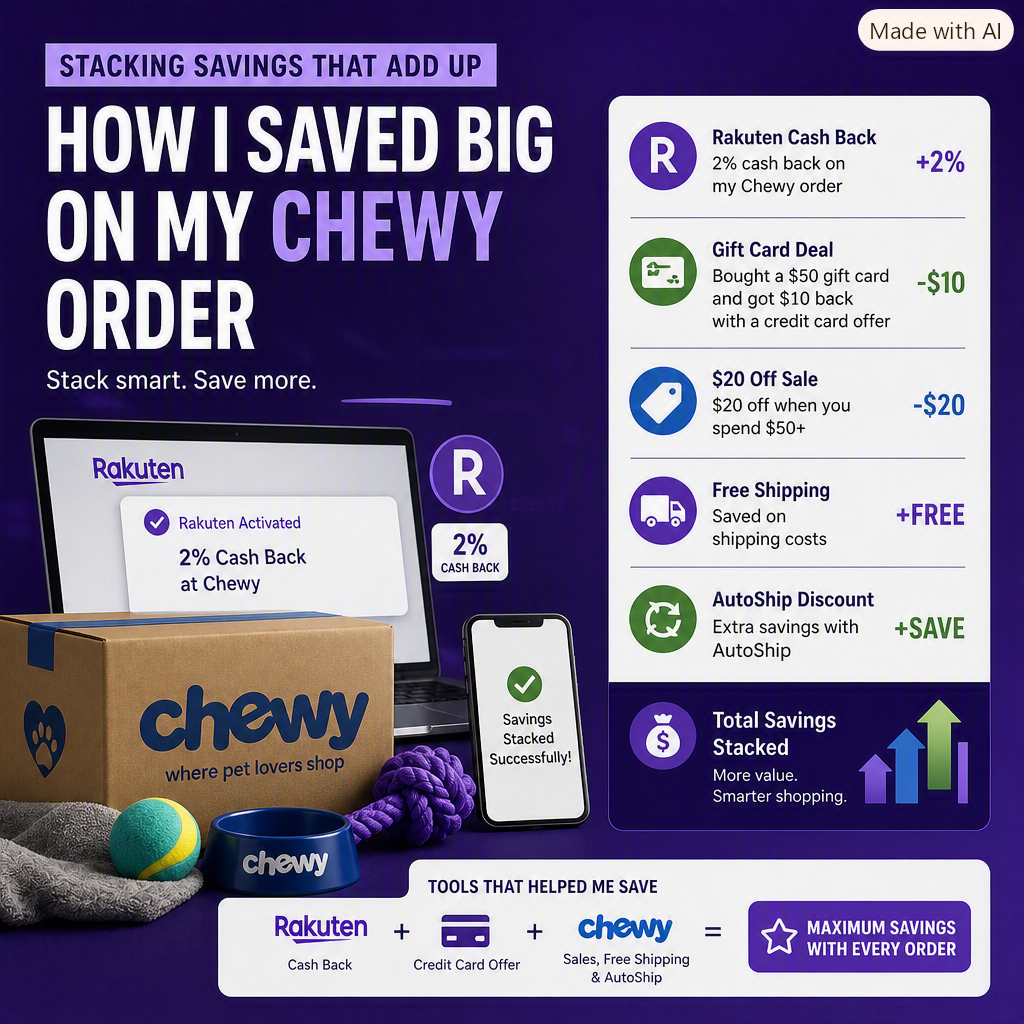
The bottom line: If you're a Costco or Sam's Club member, the warehouse route is hard to beat on simplicity — cheap gas plus the Costco Visa and you're done. If you're a regular Kroger, Ralph's, or Safeway shopper, the grocery route gives you more stacking room: fuel points plus a gas credit card plus Upside can push your effective savings even higher. The same stacking philosophy works at the grocery store and at restaurants — see how to get 15–20% back on groceries and how to earn up to 26% back when eating out. And if there's a new car in your near future, check whether its VIN qualifies for the car loan interest deduction before you sign — it's decided at the dealership, not at tax time. The one household bill where stacking works differently is electricity, since you can't switch stations — there, the rate plan itself is the lever. The same layering habit works on pet supplies and other online orders too — see how a cash-back browser extension, a gift card trick, and a site sale cut a $65 Chewy order down to about $32.
Frequently Asked Questions
How much cheaper is warehouse club gas?
Costco and Sam's Club typically price gas $0.20–$0.40 per gallon below name-brand stations like Chevron or Shell. For the average American buying about 500 gallons a year, that's $100–$200 in savings before any other layer is added.
How do grocery store fuel points work?
Kroger-family stores (like Ralphs) partner with Shell, and Safeway partners with Chevron. You earn 1 point per $1 spent on groceries, and every 100 points takes $0.10 off per gallon, valid on up to 35 gallons per fill-up. Points generally expire at the end of the following month, so redeem them regularly.
What's the gift card trick for extra fuel points?
Buying gift cards at Kroger/Ralphs earns 2x fuel points. If you're going to spend at a restaurant, Amazon, or another retailer anyway, buying the gift card at the grocery store first doubles your fuel point earn on that spending.
Can you combine the warehouse club and grocery rewards strategies?
Not directly — fuel points redeem at partner stations like Shell or Chevron, not at Costco pumps. Pick the strategy that fits where you shop, then layer a gas-earning credit card on top, like the Costco Anywhere Visa's 4% back on gas worldwide.