⚠️ Not financial advice: This post is for educational purposes only. I'm not a licensed financial advisor. Please do your own research and consult a professional before making any financial decisions.
🤖 This article was produced with AI assistance and reviewed by our editorial team.
During open enrollment at a new job, most people spend about four minutes on benefits — long enough to pick the health plan they recognize and click "confirm." If there's a box asking about an HSA, most people skip it. They're not sure what it is, and it sounds complicated. They move on.
That four-minute decision costs them thousands of dollars a year.
The Health Savings Account is the single most tax-advantaged account available to most Americans — more efficient than a Roth IRA, more efficient than a 401(k). The catch is that almost nobody explains it properly. This post does.
What an HSA actually is
A Health Savings Account (HSA) is a tax-advantaged savings and investment account specifically for healthcare expenses. You open one when you're enrolled in a qualifying High-Deductible Health Plan (HDHP) — a type of health insurance with lower monthly premiums and higher deductibles than traditional plans.
To qualify for an HSA in 2026, your health plan must have a minimum annual deductible of $1,700 for individual coverage or $3,400 for family coverage (per IRS Revenue Procedure 25-19). The out-of-pocket maximum for HSA-eligible plans is capped at $8,500 (individual) or $17,000 (family) as of 2026.
Once you're enrolled in a qualifying HDHP, you can contribute to an HSA — through your employer, on your own, or both. The 2026 contribution limits are:
- Individual coverage: up to $4,400 per year
- Family coverage: up to $8,750 per year
- Age 55+: add a $1,000 catch-up contribution on top of either limit
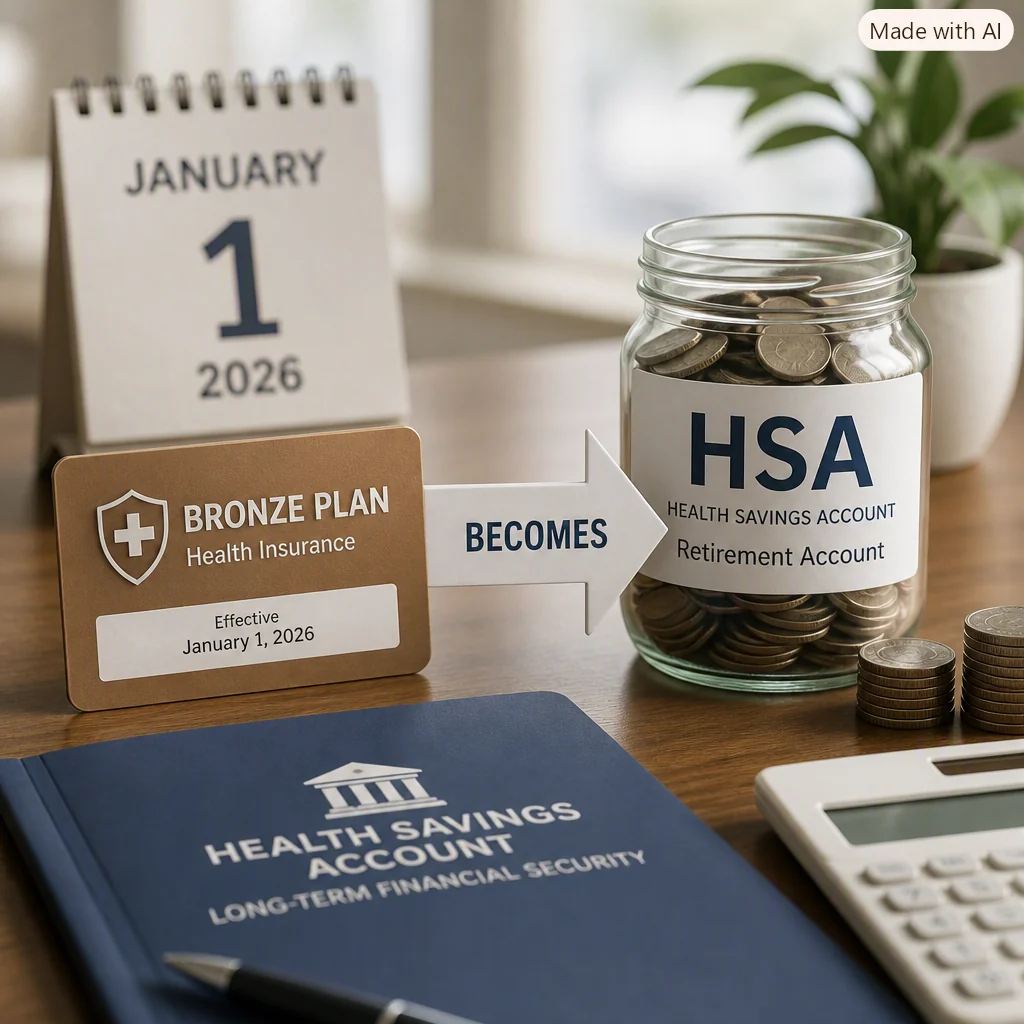
One important update: the 2025 One Big Beautiful Bill Act expanded HSA eligibility to more Americans. As of January 2026, more Affordable Care Act plan types qualify as HSA-compatible, including certain Bronze and Catastrophic plans, Direct Primary Care arrangements, and plans that include telehealth coverage. If you were previously ineligible, it's worth rechecking.
The triple tax advantage — and why it's unique
Every tax-advantaged account gives you some benefit. The HSA gives you all three.
| Account | Tax-deductible contributions? | Tax-free growth? | Tax-free withdrawals? |
|---|---|---|---|
| Traditional 401(k) | ✓ | ✓ | ✗ (taxed on withdrawal) |
| Roth IRA | ✗ (after-tax) | ✓ | ✓ |
| HSA | ✓ | ✓ | ✓ (for medical expenses) |
To put it plainly: when you contribute to an HSA, you don't pay income tax on that money going in. While it sits in the account, it can be invested and the gains are never taxed. When you withdraw it for qualified medical expenses, you don't pay tax on the way out either. No other account type does all three.
The 401(k) taxes you on the back end. The Roth taxes you on the front end. The HSA — used correctly — taxes you at none of those points.
The mistake most people make: treating it like a debit card
Here's how most people use their HSA: they get a $180 bill after a doctor's visit, open the HSA app, and tap to pay. Done. Money gone.
That's not wrong, exactly — the account is designed for exactly that. But it means they're using a triple-tax-advantaged investment vehicle as a slightly more convenient payment method. The real power of an HSA has nothing to do with paying today's medical bills.
The real move is this: invest your HSA contributions, pay medical bills out of pocket, and save every receipt.
If you can afford to cover small-to-medium medical expenses from your regular income — the way you'd cover a car repair or a dental cleaning — you should. Every dollar you leave in the HSA can be invested in low-cost index funds, grow tax-free for decades, and be withdrawn tax-free later. Using the HSA to pay a $180 bill today means that $180 never compounds. Left invested, it could be $500 or more by the time you retire.
The receipt trick: how to use your HSA as a stealth retirement account
This is the strategy most people never hear about — and it's completely legal.
The IRS has no time limit on HSA reimbursements. A qualified medical expense you paid out of pocket in 2026 can be reimbursed from your HSA in 2046 — tax-free — as long as the expense occurred after you opened the account. There is no deadline. A receipt from today is valid for a reimbursement twenty years from now.
The strategy works like this:
- Open an HSA and start contributing up to the annual limit.
- Invest the balance in low-cost index funds (more on where below).
- Pay all out-of-pocket medical expenses from your regular checking account — not the HSA.
- Save every receipt: doctor visits, prescriptions, dental, vision, therapy, medical equipment. A folder on your phone or a Google Drive works fine.
- Let the HSA grow, untouched, for years or decades.
- In retirement — or whenever you need the cash — pull out the accumulated receipts and reimburse yourself from the HSA, tax-free.
The math on this is genuinely compelling. If you contribute $4,400 per year to an HSA starting at age 30 and invest it in a broad index fund averaging 8% annually, you'll have approximately $540,000 by age 65 — all of it available tax-free for medical expenses in retirement. Medicare doesn't cover everything. Long-term care is expensive. That tax-free pool specifically earmarked for healthcare costs is exactly where you want money when you're older.

Where to actually keep your HSA (your employer's default may not be the best choice)
Many employers offer an HSA through a default provider — and many of those providers are genuinely bad for investing. They charge monthly fees, require a minimum cash balance of $1,000–$2,000 before you can invest anything, and offer a limited menu of mediocre funds with high expense ratios.
If your employer contributes to your HSA (free money — always capture that first), you may be able to transfer the balance periodically to a better provider. You're allowed one HSA rollover per year without tax consequences.
For standalone investing HSAs, two providers stand out in 2026:
Fidelity HSA
The best overall pick for most people. Zero account fees, no minimum balance required before investing, and access to Fidelity ZERO funds with 0.00% expense ratios. You can invest in individual stocks, ETFs, and thousands of mutual funds. No hoops to jump through — contribute and invest immediately.
Lively HSA
Uses the Schwab investment platform and offers broad access to stocks, ETFs, and over 13,000 mutual funds. No fees if your Lively cash balance stays above $3,000; $24/year if it drops below. Simpler interface than Fidelity and strong customer support. A solid second choice, especially if you already use Schwab.
Both are dramatically better than the average employer-provided HSA for long-term investing. If your employer's default HSA has high fees or a large cash-minimum requirement, it's worth setting up your own and rolling over periodically.
The HDHP trade-off: when an HSA actually makes sense
The triple tax advantage is real, but it comes with a real trade-off: you have to be enrolled in a high-deductible health plan. That means paying more out of pocket before insurance kicks in — $1,700 minimum for individual coverage in 2026.
This trade-off works in your favor in certain situations and against you in others.
An HDHP + HSA tends to work well if:
- You're generally healthy with few or predictable medical expenses
- You have enough in savings (or your emergency fund) to cover the deductible if needed — see our emergency fund guide for how to calculate that buffer
- Your employer offers meaningful HSA contributions that offset the higher deductible
- You're earlier in your career and prioritizing long-term tax efficiency over immediate coverage
An HDHP + HSA tends to work against you if:
- You have a chronic condition requiring frequent specialist visits, medications, or procedures
- You're planning a major medical event — surgery, pregnancy, or similar — in the near term
- You don't have the cash on hand to cover the deductible if something unexpected happens
- You're close to meeting a lower-deductible plan's out-of-pocket maximum anyway
Run the actual math before open enrollment. Take your expected medical expenses for the year, model out total costs under both plans (premiums + out-of-pocket), and factor in the tax savings from HSA contributions. For many younger, healthier workers the HDHP wins clearly. For others it doesn't. The right answer depends on your specific situation — not the default.
If you're building the full picture of how to prioritize your accounts, the Roth IRA vs. 401(k) guide covers where HSA fits in the broader priority order — and the one-page investing plan shows how all three accounts stack together.
What happens to your HSA money after age 65
Two things change when you turn 65. First, you can no longer contribute to an HSA if you're enrolled in Medicare (Medicare enrollment disqualifies you from making new contributions). Second — and this is important — the 20% penalty on non-medical withdrawals disappears entirely.
After 65, you can withdraw HSA funds for any reason, not just medical expenses. Non-medical withdrawals are taxed as ordinary income — exactly like a traditional IRA or 401(k) distribution. That's still useful: it means the HSA functions as a traditional retirement account for any funds you don't end up needing for healthcare.
And unlike a traditional IRA, your HSA has no required minimum distributions (RMDs). You're never forced to pull money out. The balance can stay invested as long as you want, on your own timeline.
HSA vs. FSA: the key difference
A Flexible Spending Account (FSA) is often offered alongside or instead of an HSA, and they're easy to confuse. The critical difference:
- FSA: Use it or lose it. The IRS allows employers to let you carry over up to $680 into 2026, or offer a 2.5-month grace period — but any remaining balance beyond that is forfeited. FSAs are owned by your employer, not you. If you leave the job, you lose the funds.
- HSA: Rolls over forever. Unused balances accumulate year after year with no cap. The account belongs to you regardless of where you work. You can take it with you when you change jobs.
You generally cannot have both an HSA and a standard health FSA at the same time — they conflict. You can pair an HSA with a Limited Purpose FSA (LPFSA), which covers only dental and vision, if your employer offers one. That combination lets you preserve your HSA balance for long-term investing while using the LPFSA for predictable dental and vision costs.
How to get started in the next 10 minutes
- Check if your health plan qualifies. Look for "HDHP" or "HSA-eligible" in your plan documents. If you're unsure, call HR or check your insurance portal. The minimum deductible threshold for 2026 is $1,700 individual / $3,400 family.
- Elect the HDHP during open enrollment (or check if you can make a mid-year change if you recently became eligible). If your employer contributes to the HSA — free money — make sure you're capturing it.
- Open a standalone HSA at Fidelity if your employer's HSA has high fees or a cash-minimum before investing. You can contribute directly there up to the annual limit.
- Set up automatic contributions. Divide your annual limit by 12 and auto-transfer monthly. $4,400 ÷ 12 = $367/month for individual coverage. Set it and forget it.
- Invest the balance. At Fidelity, go to your HSA, select "Invest," and choose a total market index fund. FZROX (0.00% expense ratio) is a solid starting point. At Lively, link to Schwab and invest in a low-cost ETF like VTI.
- Start the receipt folder. Create a folder in Google Drive, Dropbox, or Apple Notes labeled "HSA Receipts." Every time you pay a medical expense out of pocket, take a photo of the receipt and drop it in. This takes 30 seconds per receipt and builds your future tax-free reimbursement reserve.
💡 The order of operations: Capture your full employer HSA match first → then max your 401(k) to get the full employer 401(k) match → then max your HSA → then contribute to a Roth IRA. The HSA often deserves priority over the Roth because the tax efficiency is higher when used correctly. The pay-yourself-first budgeting system covers how to automate all of these contributions so they happen without thinking about it every month. And note where the kids' accounts land in that order — after your own: our comparison of Trump Accounts vs. a 529 vs. a custodial Roth explains why funding your retirement first isn't selfish, it's the math.
Frequently asked questions
Does HSA money expire if I don't use it?
No — unlike an FSA, HSA funds roll over indefinitely from year to year with no cap or deadline. Unused balances stay in the account, continue to grow tax-free if invested, and can be used at any point in the future. This is one of the HSA's biggest advantages over an FSA.
Can I use HSA funds for non-medical expenses?
Before age 65: non-medical withdrawals are subject to ordinary income tax plus a 20% penalty — steep enough to make it not worth it. After age 65: the 20% penalty disappears. Non-medical withdrawals are taxed as ordinary income (the same as a traditional IRA), making the HSA function as a backup retirement account for any funds you don't need for healthcare.
What happens to my HSA if I change jobs or switch to a non-HDHP plan?
Your HSA belongs to you, not your employer — it travels with you regardless of where you work or what health plan you switch to. If you move to a non-HDHP plan, you can no longer make new contributions to the HSA, but the existing balance remains yours to invest and spend on qualified medical expenses at any time. You can still reimburse yourself for past medical expenses using the receipt method.
Is there a time limit on HSA reimbursements?
No — and this is the most underused feature of the HSA. The IRS places no deadline on when you can reimburse yourself for a qualified medical expense. As long as the expense occurred after you opened your HSA, you can claim reimbursement decades later. A medical bill you pay out of pocket today is a valid tax-free withdrawal from your HSA in 2046. Keep your receipts.
Can I have an HSA and a 401(k) and a Roth IRA at the same time?
Yes — these are separate accounts with separate contribution limits and rules. Having all three simultaneously is not only allowed, it's the recommended approach for maximizing long-term tax efficiency. The HSA covers healthcare costs tax-free, the Roth IRA covers general retirement spending tax-free, and the 401(k) reduces your taxable income today. Each fills a different role in a complete financial picture.