🔗 Heads up: Some links in this post are referral links. If you apply or sign up through them, I may receive a commission — at no extra cost to you. I only recommend products I genuinely believe in.
⚠️ Not financial advice: This post is for educational purposes only. I'm not a licensed financial advisor. Please do your own research and consult a professional before making any financial decisions.
🤖 This article was produced with AI assistance and reviewed by our editorial team.
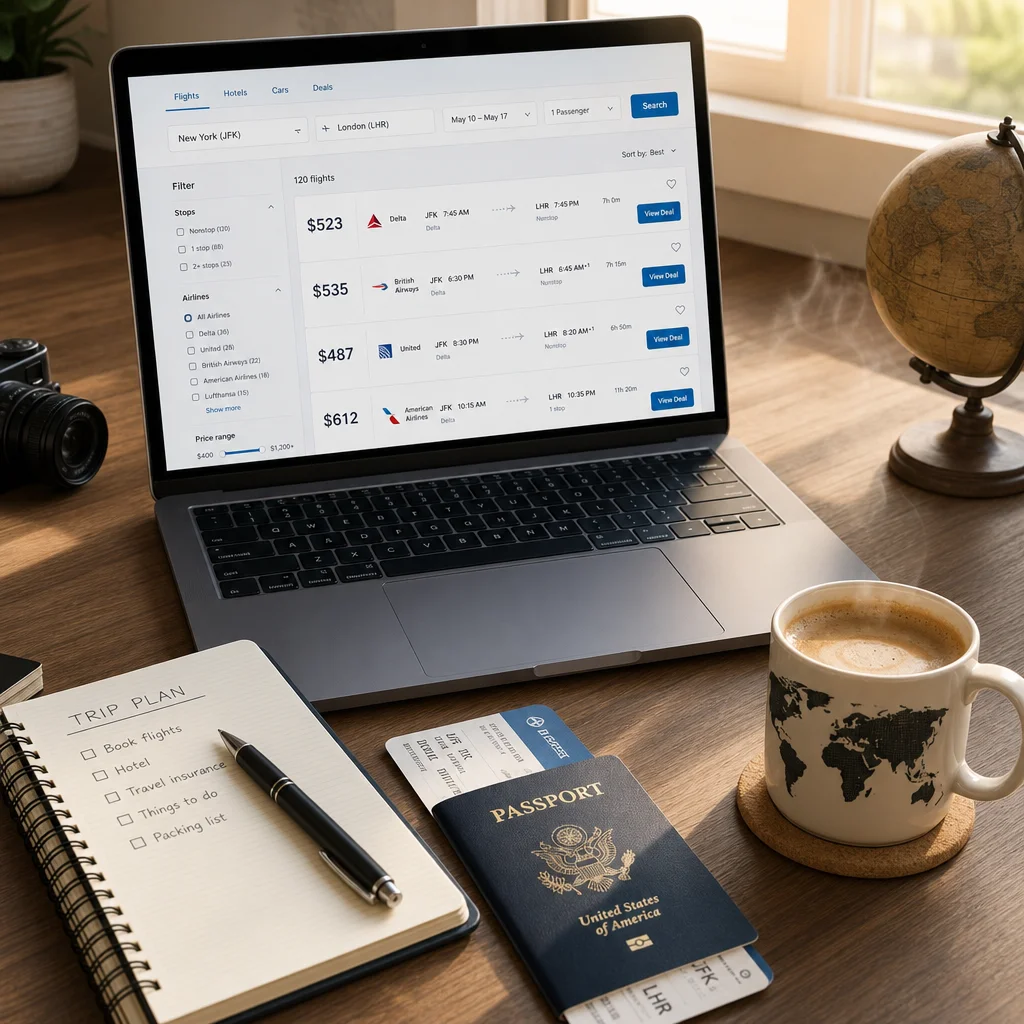
Should you use points or cash for holiday flights? Use points when they get you more than about 1.5 cents each, pay cash when they get you less than 1 cent each, and treat everything in between as a judgment call. That answer comes from one piece of division you can do on your phone while the fare is still on screen. Here is the formula, a worked Thanksgiving example, and the cases where cash wins even when the math says points.
Why Holiday Flights Break the Usual Points Advice
The standard advice is to save points for expensive flights, and holiday flights are expensive. The Points Guy reported in September 2026 that Thanksgiving fares are running 9% to 13% higher than last year and Christmas fares 12% to 18% higher. Kayak's 2026 holiday report puts the average domestic round trip at $420 for Thanksgiving and about $466 to $469 for the cheapest Christmas departure days.
The catch is that points prices move too. Most U.S. airlines now use dynamic award pricing, which means the number of miles a seat costs rises and falls with the cash fare. A flight that costs twice as much in dollars over Thanksgiving often costs about twice as many miles as well, so the "expensive flight" advantage can disappear. You can't assume points are the better deal on a peak date. You have to check.
The One Number That Settles It: Cents Per Point
Cents per point is what each point is actually buying you on a specific booking. The formula:
(Cash fare − taxes and fees on the award ticket) ÷ points required × 100 = cents per point
You subtract the taxes because an award ticket is never completely free. On a domestic round trip you still pay the federal security fee of $5.60 each way, or $11.20 total.
Then compare the result to two benchmarks. The floor is 1 cent, because points on the Chase Sapphire Preferred can be redeemed as cash back at 1 cent each, according to CNBC Select. Anything below that means you'd be better off cashing the points out and paying for the ticket. The target is 1.5 cents or more, which is the range the points site 10xTravel says airline transfer partners can routinely deliver.

Rally's two cents: "I do this math every day. One sit gets me one treat. If someone asks for a sit, a shake and a roll over for the same single treat, I know my sits just got devalued. Your points work the same way. Find out what each one is buying before you hand over forty thousand of them."
A Worked Example: One Thanksgiving Round Trip, Three Ways to Pay
Say you hold a Chase Sapphire Preferred and the round trip home for Thanksgiving costs $420, which is Kayak's national average. The award prices below are illustrative, so plug in the real numbers from your own search.
| How you pay | What it costs | Cents per point |
|---|---|---|
| Chase Travel portal, standard rate | 42,000 points | 1.0 |
| Chase Travel portal, with Points Boost on an eligible flight | As few as 28,000 points | Up to 1.5 |
| Transfer to an airline partner (example: 30,000 miles + $11.20) | 30,000 points + $11.20 | 1.36 |
Points Boost is Chase's name for a rotating set of flights and hotels where points are worth more than the standard rate. CNBC Select lists the ceiling at 1.5 cents for the Chase Sapphire Preferred, but 10xTravel reported in April 2026 that many Boost offers have dropped to around 1.15 cents, so treat 1.5 as the best case.
The transfer row is where the formula earns its keep: ($420 − $11.20) ÷ 30,000 × 100 = 1.36 cents. That beats the standard portal rate comfortably. If the same award cost 45,000 miles instead, the math drops to 0.91 cents and the portal, or plain cash, wins. Chase points transfer 1:1 to nine airline programs, including United, Southwest and JetBlue. If you haven't used transfer partners before, our beginner's guide to earning and transferring points covers the mechanics.
When Cash Wins Anyway
A decent cents-per-point number doesn't end the conversation. Cash is still the better move in three situations.
You have a better use for the points. Points you spend at 1.2 cents on a domestic hop can't be spent at 2 cents or more on a bigger trip next year. If you're building toward something specific, like the trips in our guide to pooling points for family travel, protect the balance.
You'd give up what a cash ticket earns. A $420 fare charged to the Chase Sapphire Preferred earns 2 points per dollar on travel, or 840 points, plus whatever airline miles the ticket earns. Award tickets booked with miles generally earn neither.
The gap is small and cash isn't tight. Between 1.0 and 1.3 cents, you're not getting much for your points. If paying cash won't put the trip on a card balance, keep the points. If it would, use them, because no redemption rate is worse than 20%-plus interest. The same logic runs through our holiday shopping stack: rewards only count when the bill gets paid in full.
Book Now, Re-Check Later
Timing matters more than usual this year. Kayak found the lowest Thanksgiving fares show up about five weeks out, which is the week of October 19, and that waiting costs as much as 16% more the week before the holiday and 21% more during Thanksgiving week. The Points Guy's advice for both Thanksgiving and Christmas was to book by the end of September, so anyone still shopping should move now.
Points make it easier to commit early because many award tickets can be undone. United and Southwest charge no fee to cancel an award ticket and return the miles, according to One Mile at a Time, as long as you cancel before departure. JetBlue does the same except on its Blue Basic fares. That gives you a simple routine:
- Run the cents-per-point math today and book the option that wins.
- Set a free price alert on Google Flights for the same route and dates.
- If the award price drops, cancel and rebook for fewer miles. If the cash fare drops far enough to flip the math, cancel the award and pay cash.
Two cautions. Portal bookings through Chase Travel follow the airline's fare rules, so a basic economy ticket bought with points is usually just as locked in as one bought with cash. And cancellation policies change, so confirm the airline's current rule before you rely on it. These were accurate as of October 2026.
Frequently Asked Questions
Is it too late to book holiday flights with points?
No, but the window is closing. Kayak's 2026 holiday report puts the lowest Thanksgiving fares about five weeks out, around the week of October 19, and award prices on most U.S. airlines rise along with cash fares. Run the cents-per-point math now, book if it clears your floor, and re-check the price afterward.
Do flights booked with points earn airline miles?
It depends on how you book. A flight booked through a card travel portal such as Chase Travel is usually treated as a paid ticket, so it generally earns airline miles. An award ticket booked with airline miles after a transfer generally does not earn miles or count toward elite status.
What if I don't have enough points to cover the whole fare?
Chase Travel lets you split a booking between points and your card, so you can cover part of the fare with points and pay cash for the rest. Transfer partners are stricter: you need the full mileage amount in the airline account before you can book. Transfers from Chase are one-way and cannot be reversed, so confirm the award seat is available before you move any points.
Need Points Before Next Year's Holidays?
The Chase Sapphire Preferred is the card this example is built on. Check the current offer through our referral link, at no extra cost to you.
See the Chase Sapphire Preferred offer →