⚠️ Not financial advice. This article is for informational and educational purposes only. Tax rules are specific to your situation — confirm your plan's eligibility and talk to a tax professional before making contribution decisions. Figures are current as of August 2026.
If you buy your own health insurance, something quietly happened on January 1 that's worth real money to you: every ACA Bronze and catastrophic plan is now automatically HSA-eligible. You didn't have to switch plans. You didn't have to apply. You probably weren't told.
That matters because a Health Savings Account — an HSA — is the single most tax-advantaged account available to an American, and until this year most marketplace shoppers were locked out of it. If you're freelance, contract, self-employed, or between jobs, this is the biggest tax break you've been handed in years, and it's sitting unused.
What Actually Changed in January
The change came through the One Big Beautiful Bill Act, which expanded the legal definition of a qualified high-deductible health plan — the type of insurance you must have to contribute to an HSA. In December 2025, the IRS issued Notice 2026-5 confirming the details, and the expansion took effect January 1, 2026.
The practical result: all Bronze and catastrophic plans sold on the ACA marketplace now count as qualified plans, whether or not they would have met the old deductible tests. Benefits providers have called it the biggest change to HSAs in nearly two decades.
Two smaller wins landed at the same time. Direct primary care — a flat monthly fee paid straight to a doctor for routine visits — no longer disqualifies you from contributing, up to $150 a month for individuals and $300 for families. And telehealth coverage before you hit your deductible is now permanently allowed rather than a temporary pandemic-era carve-out.
Why an HSA Is the Best Account in the Tax Code
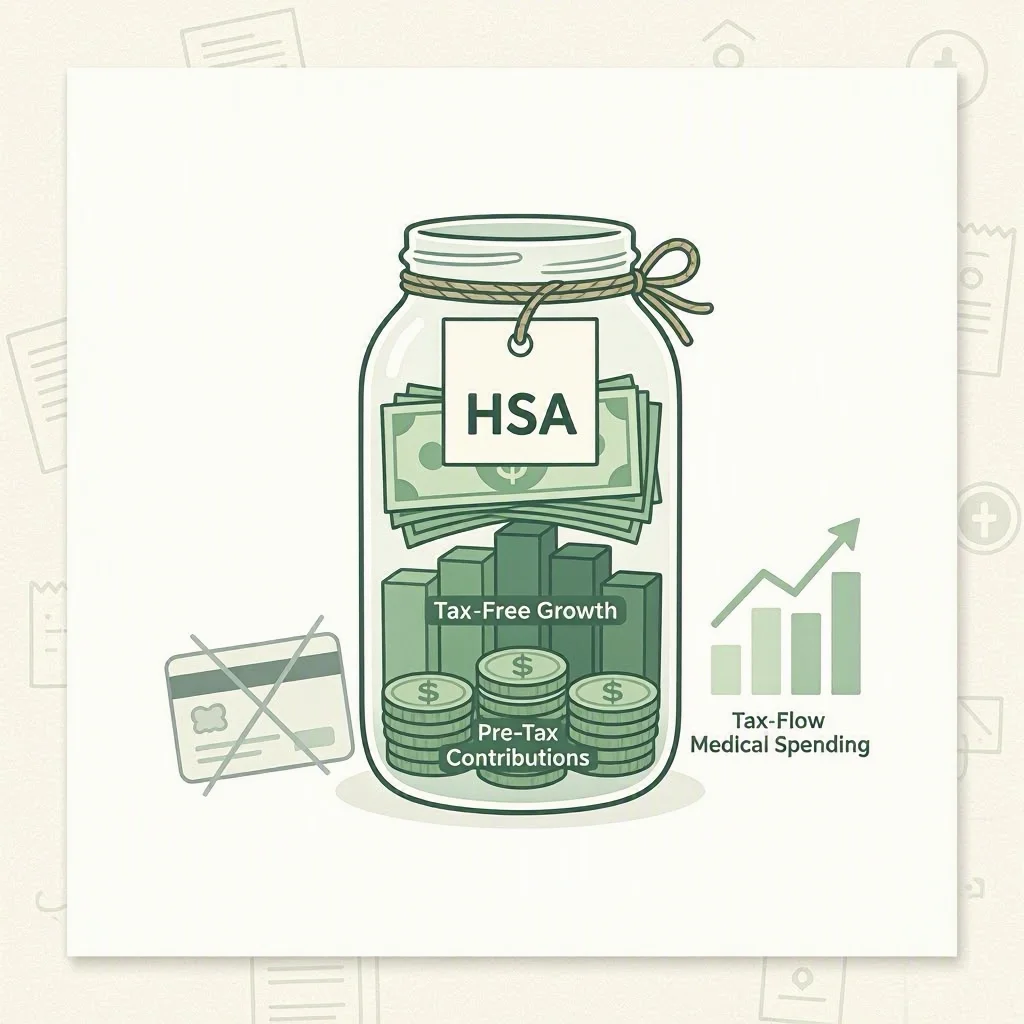
Most tax-advantaged accounts give you one break or the other. A traditional 401(k) gives you a deduction now and taxes you later. A Roth IRA taxes you now and lets withdrawals out free. An HSA is the only account that does both, plus a third thing in the middle.
For 2026 you can put in $4,400 with self-only coverage or $8,750 with family coverage, plus another $1,000 if you're 55 or older and not on Medicare. You have until the following April's filing deadline to contribute for a given tax year.

Rally's two cents: "I am handed one treat at a time. Never three at once. So when someone tells me an account is tax-free going in, tax-free while it sits there, and tax-free coming out, my ears go up. That is three treats. Nobody gives you three treats. Take them."
How to Check Whether Your Plan Qualifies
The rule is broad, but confirm before you contribute — the penalty for putting money into an HSA you weren't eligible for is a real headache. Three steps:
1. Find your metal tier. Log into HealthCare.gov or your state marketplace and look at your plan summary. If it says Bronze, Expanded Bronze, or Catastrophic, you're covered by the new rule. Silver, Gold, and Platinum plans are unchanged — they qualify only if they independently meet the deductible tests.
2. Look for the HSA-eligible flag. Marketplace plan listings carry an "HSA-eligible" label. As of 2026 this should appear on Bronze and catastrophic plans automatically. If your plan documents disagree with the metal tier, call the insurer rather than guessing.
3. Confirm you have no disqualifying coverage. This trips people up more than the plan itself. Being enrolled in Medicare, being claimed as a dependent on someone else's return, or having a general-purpose health FSA — including through a spouse's employer — will block you from contributing even with a qualifying plan.
⚠️ The plan being eligible doesn't open the account. These are two separate steps, and it's where most people stall. You have to go open an HSA yourself through a bank or an HSA provider. Nothing happens automatically just because your insurance now qualifies.
The Move That Turns It Into a Retirement Account
Here's what separates people who use an HSA from people who really use one. Most treat it as a checking account for medical bills: money goes in, a prescription gets paid, the balance stays near zero. That captures the tax deduction and nothing else.
The stronger play, if your cash flow allows it: contribute the max, invest the balance, pay medical costs out of pocket, and keep every receipt. Qualified medical expenses have no deadline for reimbursement. A receipt from 2026 can be reimbursed from your HSA in 2050, tax-free, after the money has spent 24 years compounding.
Take a 32-year-old freelancer on a Bronze plan who contributes the $4,400 self-only maximum every year and invests it, assuming a 7% average annual return:
| Line item | Amount |
|---|---|
| Contributed over 25 years ($4,400 × 25) | $110,000 |
| Investment growth, untaxed | $168,296 |
| Balance at 57 | $278,296 |
Roughly $168,000 of that is growth that never gets taxed — provided it goes toward medical costs, which for most people in retirement is not a difficult condition to meet. And every one of those $4,400 contributions also lowered that year's taxable income along the way, worth around $968 in the 22% bracket.
One honest caveat for the self-employed: when you contribute to an HSA on your own rather than through an employer's payroll plan, the deduction reduces your income tax but not your self-employment tax. It's still an excellent deal — just not quite the double-dip that employees with payroll deductions get.
The Catches Worth Knowing
Bronze means real out-of-pocket exposure. Low premiums are the trade for a high deductible. Before you route spare cash into investments inside the HSA, make sure you could actually absorb a bad year. Our guide to sizing an emergency fund is the right prerequisite here.
Investing usually requires a minimum cash balance. Most HSA providers hold the first $1,000 to $2,000 in cash before letting you invest the remainder. Compare providers on that threshold and on fees — they vary a lot more than brokerage accounts do.
Non-medical withdrawals are punished before 65. Take money out for something other than a qualified medical expense and you'll owe income tax plus a 20% penalty. After 65 the penalty disappears and non-medical withdrawals are simply taxed as income, which is what makes an HSA behave like a traditional IRA in later life.
Keep receipts somewhere durable. The reimburse-later strategy only works if you can prove the expense years afterward. A folder in cloud storage is enough — but it has to actually exist.
The Bottom Line
If you're on a Bronze or catastrophic marketplace plan, you gained access in January to an account that is deductible going in, untaxed while invested, and untaxed coming out for medical costs. Nobody sent a letter. Check your metal tier, confirm you have no disqualifying coverage, open the account, and — if you can afford to leave it alone — invest it rather than spending it. If you want the broader picture of how an HSA fits alongside your other accounts, our full HSA guide covers the employer-plan side, and the Roth versus 401(k) breakdown explains where it sits in the priority order.
Frequently Asked Questions
Is my Bronze plan automatically HSA-eligible in 2026?
Yes. Under the One Big Beautiful Bill Act, confirmed by IRS Notice 2026-5 in December 2025, all ACA Bronze and catastrophic plans count as qualified high-deductible plans as of January 1, 2026. You don't need to switch or apply — but you do still need to open an HSA yourself, since the plan qualifying and the account existing are separate things.
What are the 2026 HSA contribution limits?
$4,400 for self-only coverage and $8,750 for family coverage, plus a $1,000 catch-up if you're 55 or older and not enrolled in Medicare. Contributions for a tax year can be made until that following April's filing deadline.
Can you invest money inside an HSA?
Yes, at most providers — though many require a cash minimum, often $1,000 to $2,000, before the rest can be invested. Gains are untaxed, and withdrawals for qualified medical expenses are untaxed too, which is what makes it the only triple-tax-advantaged account in the code.
What happens to my HSA if I switch to a plan that isn't eligible?
The account stays yours forever. You just stop contributing for any month you're not on a qualifying plan. Existing money keeps growing tax-free and can still be withdrawn tax-free for medical costs whenever you need it.