
🔗 Heads up: Some links in this post are referral links. If you apply or sign up through them, I may receive a commission — at no extra cost to you. I only recommend products I genuinely believe in.
⚠️ Not financial advice: This post is for educational purposes only. I'm not a licensed financial advisor. Please do your own research and consult a professional before making any financial decisions.
🤖 This article was produced with AI assistance and reviewed by our editorial team.
Here's a stat that should make you put your phone down for a second: according to a September Freedom Debt Relief study reported by Fortune, 59% of Gen Z cardholders pay only the minimum on their credit cards, the highest share of any generation. And only 20% know their card's exact interest rate.
Either of those alone is fixable. Together, they're the minimum-payment trap: you're paying a price you've never actually looked at, as slowly as the bank allows. The good news is that getting out starts with about 10 minutes and one phone call. Here's how.
Why "Minimum Only" Plus "No Idea of My APR" Is So Expensive
Your APR (annual percentage rate) is what your card charges per year to borrow the balance you don't pay off. The average rate on credit card accounts that were charged interest was 22.36% in August 2026, according to the Federal Reserve's consumer credit data. That's a little under 2% of your balance every single month.
The minimum payment is designed to cover that month's interest plus a sliver of the balance, often about 1%. So when you pay only the minimum, most of your money goes to the bank and very little goes to the debt. Not knowing your rate makes it worse, because you can't tell whether a balance transfer, a payoff plan, or a quick call would save you $50 or $5,000.
This isn't a character flaw. In the same survey, 37% of Gen Z said they don't earn enough to pay more than the minimum, and 51% said they feel embarrassed about their card debt. The fix below is designed to work even if your budget is tight.
Find Your Real APR in 2 Minutes
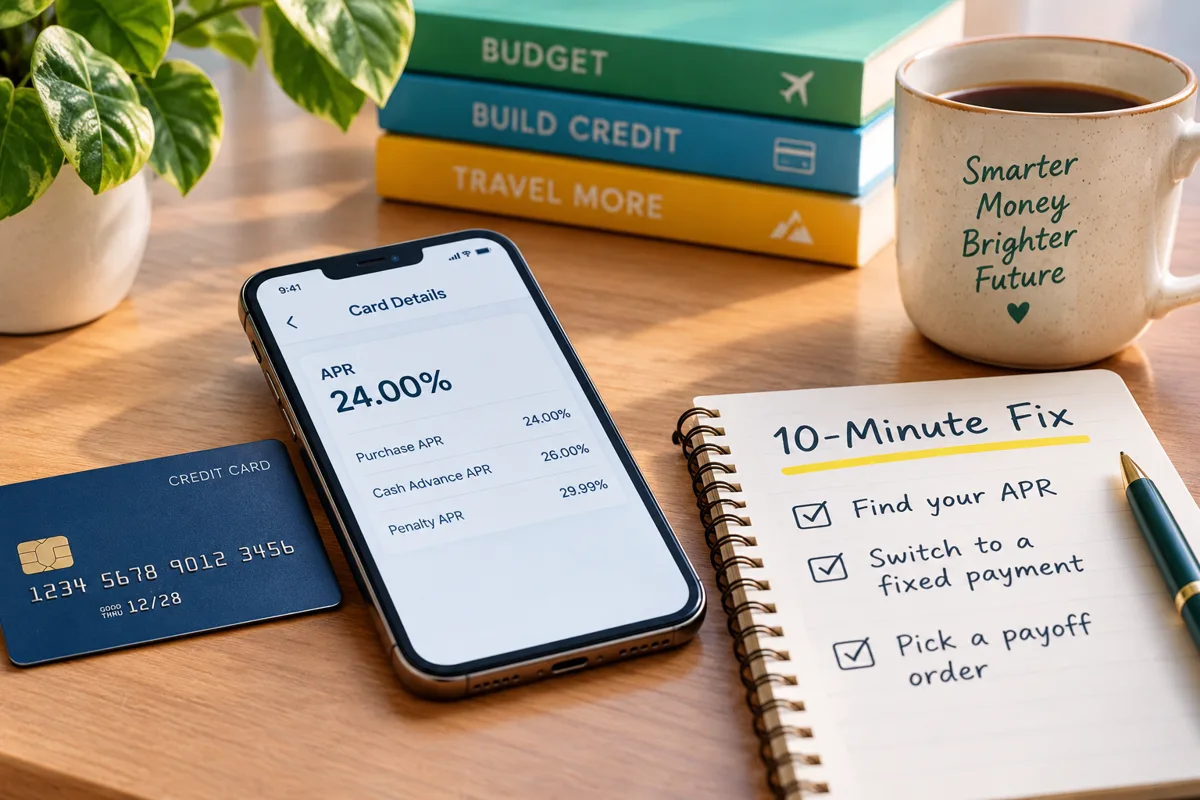
Open your card's app or your latest statement and look for the box labeled "Interest Charge Calculation." It's usually on the last page of the statement or under "Account details" or "Rates and fees" in the app. You'll see a few different rates:
- Purchase APR: the rate on everyday spending. This is the one that matters most for most people.
- Cash advance APR: often several points higher, and it starts charging interest the same day you take the cash.
- Penalty APR: a much higher rate, often near 30%, that can kick in if you pay 60+ days late.
Write down the purchase APR and current balance for every card you carry a balance on. That's it. You've just joined the 20%.
What Minimum-Only Actually Costs: One Example
Say you carry $3,000 at the 22.36% average rate, and your issuer sets the minimum at 1% of the balance plus that month's interest (a common formula, with a $25 floor). Your first minimum is about $86, and it shrinks as the balance shrinks, which is exactly why it takes so long.
| Payment plan | Time to $0 | Total interest |
|---|---|---|
| Minimum payment only | About 15 years | ≈ $4,515 |
| Fixed $150 a month | About 26 months | ≈ $789 |
| Fixed $150 + APR cut to ~16% | About 24 months | ≈ $515 |
Paying only the minimum, that $3,000 costs you more than $4,500 in interest, which is more than the original balance. Bumping to a flat $150 a month cuts that to under $800. You don't have to guess your own version, either. Thanks to the federal CARD Act, every statement includes a "Minimum Payment Warning" box showing how long payoff takes at the minimum and what it takes to finish in three years. Find yours. It's the most honest paragraph your bank will ever send you.
Rally's take: Fifteen years? I'll be a very old, very fluffy gentleman by then. That's $4,515 the bank gets for doing nothing. I would like that money in treat form, please. 🐩
The 10-Minute Fix: Three Moves
1. Call and ask for a lower rate (5 minutes)
This works far more often than people think. In a LendingTree survey reported in September 2026, 84% of cardholders who asked for a lower APR got one, with an average cut of 6.3 percentage points. Call the number on the back of your card and try: "I've been a customer for [X] years, and I'm working on paying this balance down. Is there anything you can do to lower my interest rate?" If the first person says no, politely ask whether there are any hardship or retention offers.
2. Switch autopay from "minimum" to a fixed amount (3 minutes)
Most people's autopay is quietly set to "minimum due." Change it to a fixed dollar amount, even $25 or $50 above your current minimum. A fixed payment doesn't shrink as your balance falls, which is what turns 15 years into about two. If cash is tight, pick a number you can sustain, then raise it whenever you get a raise or pay off something else. Our guide to setting up an automated budget shows how to build it into your paycheck so you never have to think about it.
3. Pick a payoff order (2 minutes)
Got more than one card? Pay the minimum on all of them and put every extra dollar toward one target: either the highest APR (the avalanche method, which saves the most) or the smallest balance (the snowball method, which builds momentum). Our breakdown of debt avalanche vs. snowball helps you choose the one you'll actually stick with.
When a 0% Balance Transfer Makes Sense
A balance transfer moves your debt to a new card with a temporary 0% intro APR. For example, the Discover it Cash Back card has offered 0% on balance transfers for 15 months with a 3% transfer fee (as of October 2026; a separate 18-month balance transfer version of the card also exists, and offers change, so check the current terms). On our $3,000, the fee is $90. Pay about $206 a month and the whole $3,090 is gone before the promo ends, with $0 in interest.
It only works if: you have a decent credit score (you'll need to qualify), you can pay off the balance before the promo ends, and you don't put new purchases on the old card. After the intro period, the Discover it card's regular variable APR applies to anything left over. If you can't realistically pay the balance off within the promo window, a rate cut from your current issuer plus a fixed payment may be the safer move.
Rates are also climbing. As we covered in what the Fed's September rate hike means for your money, variable card APRs rise with every hike, so locking in 0% now protects you from the next one too.
Breaking the "Pay It Down, Run It Up" Cycle
The Fortune report describes a pattern many Gen Z cardholders know well: you pay a balance down, then it creeps back up. That usually means the card is filling a gap in your budget, not that you lack willpower. Two guardrails help:
- Build a starter buffer. Even $500 in savings means a surprise car repair doesn't go straight back on the card. Our emergency fund guide walks through where to keep it.
- Pay the card weekly, not monthly. Paying off each week's spending right away keeps the balance from snowballing, and it makes your spending feel real again.
And if the debt feels too big to tackle alone, that's normal. A nonprofit credit counselor (look for agencies affiliated with the NFCC) can review your situation for free or low cost and may be able to set up a debt management plan with lower rates.
Your 10-minute checklist: (1) Find the purchase APR on every card with a balance. (2) Read your statement's Minimum Payment Warning box. (3) Call and ask for a lower rate. (4) Switch autopay to a fixed amount. (5) Pick your payoff target.
Frequently Asked Questions
Does paying only the minimum hurt my credit score?
Not directly. Paying the minimum on time counts as an on-time payment. But carrying a high balance raises your credit utilization (how much of your limit you're using), which can lower your score. Paying the balance down usually helps your score as utilization falls.
Will calling to ask for a lower APR trigger a hard credit inquiry?
Usually not. Most issuers review your existing account without a hard pull, but it's fine to ask the representative before they proceed. Applying for a new balance transfer card, on the other hand, typically does involve a hard inquiry.
Should I pay off my credit card before investing?
For most people, yes, with one exception: if your employer matches 401(k) contributions, contribute enough to get the full match first. Beyond that, paying off a card charging over 20% is a guaranteed return that the stock market can't reliably beat.