🔗 Heads up: Some links in this post are referral links. If you apply or sign up through them, I may receive a commission — at no extra cost to you. I only recommend products I genuinely believe in.
⚠️ Not financial advice: This post is for educational purposes only. I'm not a licensed financial advisor. Please do your own research and consult a professional before making any financial decisions.
🤖 This article was produced with AI assistance and reviewed by our editorial team.
On September 16, the Federal Reserve raised interest rates for the first time since July 2023, and this Fed rate hike is already reaching your wallet. The headline number is small, just a quarter of a percentage point, and if you only caught it on the news you probably filed it under "stuff that happens to banks." But it isn't just banks. That quarter point is showing up on credit card statements, savings accounts, and loan quotes, and the Fed has signaled it may not be the last one.
Here's the good news: you don't need to understand monetary policy to respond to it. You need about four moves, and most of them take less than an hour. Here's what changed, what it actually costs you, and what to do before the Fed meets again.
What the September 2026 Fed Rate Hike Actually Did
The Fed's rate-setting committee voted 12–0 to raise its benchmark rate to a range of 3.75% to 4.00%, up from 3.50% to 3.75%. The reason is inflation: prices, pushed higher by energy costs, have stayed above the Fed's target for more than five years, and officials decided it was time to lean on the brakes again. Their updated projections show a clear majority expect at least one more increase before the end of 2026.
Within hours, major banks raised the prime rate (the benchmark rate banks charge their most creditworthy borrowers, and the base most credit card and home equity rates are built on) from 6.75% to 7.00%. That's the pipe the Fed's decision flows through to your wallet. The next Fed meeting is October 27–28, followed by one in December, so the window to get ahead of another hike is roughly one month.
Move 1: Go After Variable-Rate Debt First
Almost every credit card has a variable APR, which means your rate is the prime rate plus a fixed margin the issuer set when you opened the card. When prime goes up, your rate follows, usually within a billing cycle or two, and it applies to the balance you already have, not just new purchases. Bankrate put the average card APR at 19.61% as of September 23, 2026, before this hike fully filters through.
Here's the honest math. Say you're carrying $6,000 on a card at about 19.9% once this hike lands. The hike itself adds roughly $15 a year in interest. If the Fed goes again in December, that's about $30. Annoying, not catastrophic. The real problem is everything underneath it: that same $6,000 costs you nearly $1,200 a year in interest at today's rates. The hike is just the reminder to deal with it.
Rally's take: I watched a $6,000 balance at 19.9% for exactly one month. That's not a number, that's a second dog who eats $100 a month and never fetches anything. 🐩
The worked example: pay it down vs. transfer it
If you pay $412 a month toward that $6,000 at 19.9%, you're debt-free in about 17 months and pay roughly $923 in interest along the way.
Now try a balance transfer, which moves the debt to a new card with a 0% introductory rate. The Discover it Cash Back card currently offers 0% intro APR on balance transfers for 15 months, with a 3% fee on balances transferred during that window (as of September 2026). On $6,000, the fee is $180, which gets added to your balance. Pay the same $412 a month and you clear the full $6,180 in 15 months, with $0 in interest. That's about $740 back in your pocket, and every future Fed hike during those 15 months stops mattering to that balance. Because the rate is fixed at 0% during the promo, it's also the one card rate the Fed can't touch.
Two rules before you transfer: Don't add new purchases to the transferred balance, and set up autopay large enough to finish before the promo ends. After 15 months, the Discover it card's regular rate is 18.49% to 28.49% variable. One more catch: Discover is now owned by Capital One, so you can't transfer a Capital One card's balance to it.
No transfer offer available? Pick a payoff order and stick with it. Our guide to the debt avalanche vs. snowball methods walks through which one saves the most versus which one you're more likely to finish.
Move 2: Make Your Cash Earn the New Rate
Rate hikes aren't all bad news. They're good for savers, but only if your savings account actually passes the increase along. Most big banks don't. The FDIC's national average savings rate was just 0.38% as of August 2026, which on $10,000 earns about $38 a year.
A high-yield savings account like Ally Bank paid 3.10% APY as of September 25, 2026, with no minimum deposit. That's about $310 a year on the same $10,000. This is the home for your emergency fund: money you need to reach quickly, earning a rate that actually moves.
The option most people skip: Treasury bills
Treasury bills (T-bills) are short-term loans to the U.S. government, lasting from a few weeks to a year. On September 25, the 13-week T-bill yielded 4.18% and the 26-week yielded 4.36%, both higher than most savings accounts. They also carry a perk that matters a lot if you live in a high-tax state like California or New York: T-bill interest is exempt from state and local income tax. You can buy them for as little as $100 through TreasuryDirect or most brokerage accounts.
The trade-off is access. A savings account lets you withdraw tomorrow, while a T-bill holds your money until it matures (though you can sell early through a brokerage). A simple split works well: one month of expenses in savings, and anything you won't need for three to six months in short T-bills.
What about locking in a long CD? When rates are rising, that's usually the wrong time to commit for years, because you could get stuck below next quarter's rate. If you like CDs, keep terms short (six to twelve months) so you can roll into higher rates if they keep climbing.
Move 3: Check Anything With an Adjustable Rate
Credit cards aren't the only debts tied to prime. Take ten minutes and check your statements for these:
Home equity lines of credit (HELOCs) are almost always variable and usually track prime directly, so they rise quickly. Private student loans can be variable. Check your servicer's statement for the word "variable." Adjustable-rate mortgages don't change immediately, only at their scheduled reset date, but if yours resets in the next year, now is the time to price out a refinance or a plan.
Just as important is what won't move: federal student loans, fixed-rate mortgages, and most auto loans have fixed rates, so this hike doesn't change what you owe on them. Don't panic-refinance a fixed loan because of a headline.
If you're about to borrow, timing matters. The 30-year mortgage rate averaged 7.03% in Freddie Mac's September 24 survey. If you're shopping for a home or a car in the next few months, getting preapproved and asking about a rate lock (a lender's guarantee to hold your quoted rate for a set period, often 30 to 60 days) before the October 27–28 meeting protects you if rates keep rising. If you're weighing whether buying makes sense at all right now, our breakdown of what housing actually costs in 2026 runs the full numbers.
Move 4: Don't Let Rate Headlines Scare You Out of Investing
Rising rates tend to rattle the stock market, and they did this month. The 10-year Treasury yield, which influences everything from mortgages to stock valuations, climbed above 5% in September for the first time since 2007. When yields jump like that, stocks often wobble while investors reprice.
If you're investing for something 10+ years away, this is a reason to keep your automatic contributions running, not to stop them. Buying through a dip means your regular contribution buys more shares at lower prices. Pausing to "wait until things settle" usually means missing the rebound. The one real opportunity here is on the bond side: higher yields mean the bond portion of a target-date fund or a bond index fund is now paying investors more than it has in nearly two decades.
The simplest way to stay on track is to take the decision out of your hands entirely. An automated budget that invests before you see the paycheck keeps working no matter what the Fed does next.
Your one-hour checklist before October 27: (1) Find every card with a balance and its APR. (2) Price out a balance transfer or pick a payoff method. (3) Move idle cash from a 0.38% account to a high-yield account or short T-bills. (4) Check HELOCs and private loans for variable rates. (5) Leave your automatic investments alone.
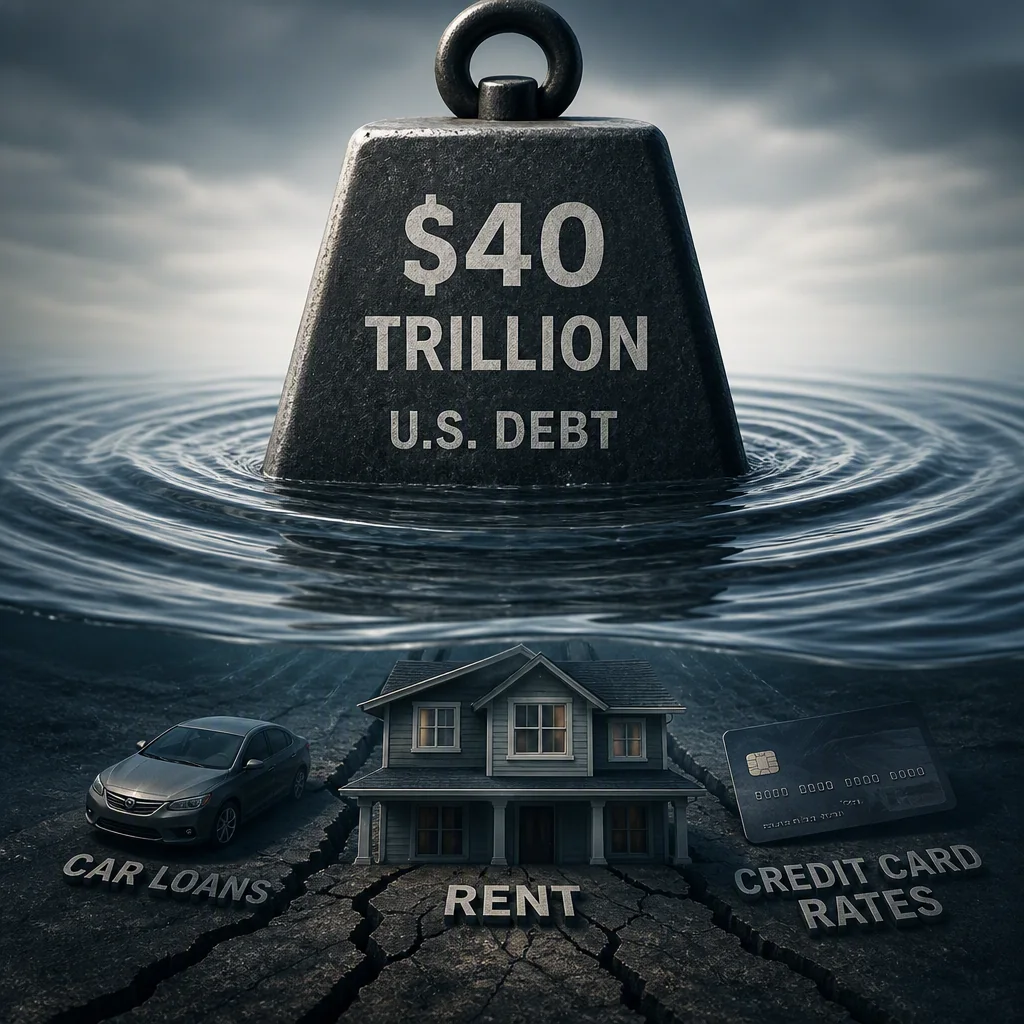
For the bigger picture on why rates are staying high, our explainer on what $40 trillion in national debt means for your rent and borrowing costs connects the dots.
Frequently Asked Questions
Will the Fed rate hike raise my mortgage payment?
Not if you have a fixed-rate mortgage. Your rate and payment are locked for the life of the loan. The hike affects new mortgages, adjustable-rate mortgages at their next reset, and home equity lines of credit, which usually track the prime rate directly.
How fast will my credit card rate go up after a Fed hike?
Usually within one or two billing cycles. Most credit cards have variable APRs set as the prime rate plus a margin, and major banks raised prime from 6.75% to 7.00% right after the September 16, 2026 decision. The higher rate applies to your existing balance, not just new purchases.
Should I lock in a CD now or wait?
When rates are expected to keep rising, short terms are usually the safer choice. A six- to twelve-month CD or a short Treasury bill lets you reinvest at higher rates later instead of locking in for years at today's rate. Keep your emergency fund in a high-yield savings account where you can reach it immediately.
When is the next Fed meeting?
The Federal Reserve's next policy meeting is October 27–28, 2026, followed by a December meeting. Fed officials' September projections showed most expect at least one more rate increase before the end of 2026.