⚠️ Not financial advice: This post is for educational purposes only. I'm not a licensed financial advisor. Please do your own research and consult a professional before making any financial decisions.
🤖 This article was produced with AI assistance and reviewed by our editorial team.
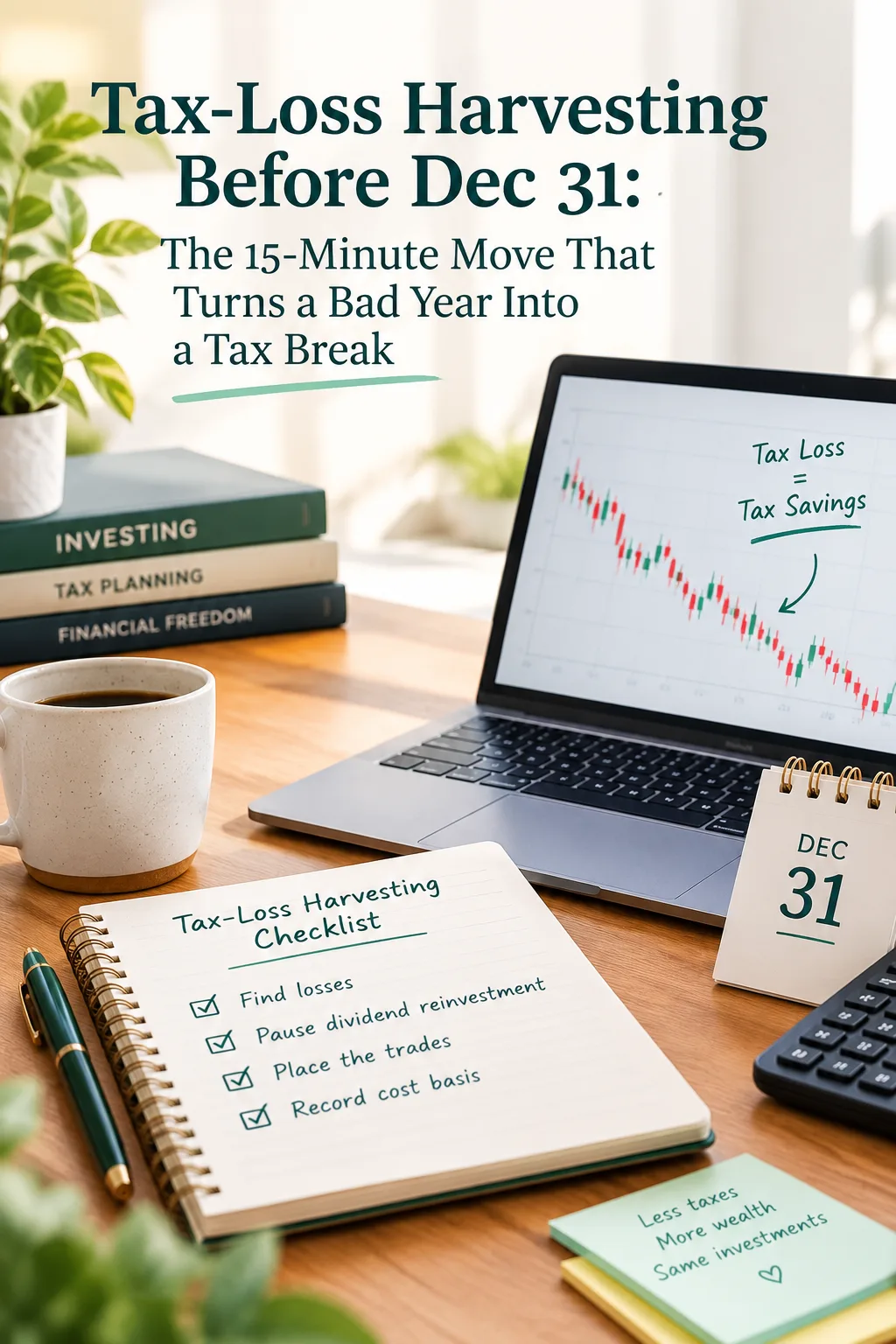
Tax-loss harvesting means selling an investment that's worth less than you paid, using that loss to cut your tax bill, and immediately putting the money back to work in something similar. You stay invested, but the IRS shares a slice of your bad luck. If you have a taxable brokerage account with a position in the red, you have until December 31, 2026 to lock in the loss for this tax year.
It's one of the few tax moves that doesn't need an accountant, a business or a high income. It just needs about 15 minutes and one rule you can't break.
What tax-loss harvesting actually is
When you sell an investment for more than you paid, that profit is a capital gain, and it's taxable. When you sell for less, it's a capital loss, and the tax code lets you use it in three ways, in this order:
- Cancel out gains. Losses offset gains dollar for dollar. Sold some Nvidia at a $2,000 profit this year? A $2,000 loss wipes out the tax on it.
- Cut your regular income. If losses exceed gains, you can deduct up to $3,000 a year ($1,500 if married filing separately) against your salary.
- Carry the rest forward. Anything above that rolls into future years with no expiration date, ready to offset future gains or another $3,000 of income.
The "harvesting" part is the trick: you don't sell and walk away. You sell and buy a similar investment the same day, so your portfolio looks almost identical, but you've banked a loss on paper. Think of it as swapping a dented can of soup for an undented can of a different brand. Same dinner, different receipt.
Who this is (and isn't) for
This only works in a taxable brokerage account, meaning a regular account at Fidelity, Schwab, Vanguard, Robinhood and so on. It does nothing inside a 401(k), traditional IRA, Roth IRA or HSA, because gains and losses inside those accounts aren't taxed year to year. (If you're still deciding where your next dollar goes, our guide to choosing between a Roth IRA and a 401(k) and our breakdown of the HSA's triple tax break come first for most people. And before you invest money in a taxable account at all, make sure your emergency fund is in place so you never have to sell at a loss to cover a surprise bill.)
It's worth your time if:
- You have a position that's down at least a few hundred dollars from what you paid.
- You've realized gains this year, from selling stock, crypto or fund distributions, or you just want the $3,000 income deduction.
- You're in the 22% federal bracket or higher, where each $1,000 of deductible loss saves $220 or more.
It's probably not worth it if your taxable income is low enough to fall in the 0% long-term capital gains bracket. For 2026, that's taxable income up to $49,450 for single filers or $98,900 for married couples filing jointly. In that range, your long-term gains are already tax-free, so the main benefit left is the $3,000 income deduction. Some people in this bracket do the opposite and "harvest gains" to reset their cost basis higher for free.
One worked example: the $1,200 loss
Meet Jordan, 31, single, earning $85,000. That puts Jordan in the 22% federal bracket. Earlier this year, Jordan put $5,000 into an international stock index fund in a taxable account. It's now worth $3,800.
Here's the 15-minute version of what Jordan does in December:
- Sells the fund for $3,800, realizing a $1,200 loss.
- Same day, buys $3,800 of a different international index fund from another provider that tracks a different index. Jordan's market exposure barely changes.
- At tax time, Jordan has no other gains, so the $1,200 loss reduces taxable income from salary.
Result: $1,200 × 22% = $264 off Jordan's federal tax bill, plus state savings in states with an income tax. If the fund bounces back, Jordan still owns the recovery through the replacement fund.
Now say the loss was $5,000 instead. Jordan deducts $3,000 this year (saving $660) and carries the remaining $2,000 into 2027 automatically.
One honest caveat: harvesting defers tax more than it erases it. Jordan's new fund has a lower cost basis ($3,800), so a future sale will show a bigger gain. The win is that you get the deduction now at your ordinary income rate, and you may pay later at the lower long-term capital gains rate, or never, if you hold until death or donate the shares.
The wash-sale trap (the one rule you can't break)
The IRS doesn't let you sell for a loss and buy the same thing right back. Under the wash-sale rule, if you buy a "substantially identical" security within 30 days before or after the sale (a 61-day window), the loss is disallowed for now. It gets added to the cost basis of the new shares instead, so it's postponed rather than gone, but it won't help this year's return.
The mistakes that catch people:
- Automatic dividend reinvestment. If the fund you sold pays a dividend that reinvests in the same fund within the window, even a $14 reinvestment can trigger a partial wash sale. Turn reinvesting off for that holding before you sell.
- Buying it in your IRA. A purchase of the same fund in your IRA or Roth IRA counts too, and per IRS Revenue Ruling 2008-5, the loss is gone for good, with no basis adjustment to make up for it. Check your 401(k) and IRA auto-investments.
- Your spouse's account. Purchases by your spouse count as yours.
- Same index, different wrapper. Selling one S&P 500 fund and buying another S&P 500 fund is a gray area the IRS hasn't clearly ruled on. The safer swap is a fund that tracks a different index, such as an S&P 500 fund for a total U.S. market fund.

Rally's take: "I once traded my squeaky duck for a squeaky goose. The humans called it 'diversifying.' I call it the wash-sale rule: you can't give up the duck and grab the same duck back an hour later. Wait 31 days, or pick a different bird."
Your 15-minute checklist before Dec 31
- Find your losses (3 min). Log in to your brokerage and open the "unrealized gain/loss" or "cost basis" view. Sort by loss. Look at individual tax lots, since shares bought at different prices can have different results.
- Check your gains (2 min). Look at "realized gain/loss" for 2026 so you know what you're offsetting. Remember that funds also pay capital gains distributions in December.
- Pause dividend reinvestment (2 min) on anything you plan to sell, and confirm nothing in your IRA or 401(k) is set to buy the same fund in the next 30 days.
- Pick a replacement (3 min). Choose a similar but not identical fund: different index, different provider. Write it down.
- Place both trades the same day (3 min). Sell first, then buy. The trade date must be on or before Thursday, December 31, 2026, so don't wait for the last afternoon.
- Record it (2 min). Save a screenshot of the sale price, date and replacement. Your brokerage's 1099-B should report it, but your own note helps if anything gets flagged.
Want this to happen without you? Many robo-advisors run tax-loss harvesting automatically in taxable accounts. If you invest on autopilot (see our one-page investing plan), it's worth checking whether yours offers it. And if you have side-hustle income, pairing this with the banking setup that keeps your side hustle taxes clean makes April a lot calmer.
Tax brackets and limits here are accurate as of October 2026 for the 2026 tax year. Confirm them against IRS guidance or a tax professional before you trade.
Frequently asked questions
Can I tax-loss harvest if I have no capital gains this year?
Yes. Losses with no gains to offset can reduce your ordinary income by up to $3,000 a year ($1,500 if married filing separately), and any extra carries forward to future years with no expiration.
Does the wash-sale rule apply to crypto?
As of October 2026, the IRS treats cryptocurrency as property, and the wash-sale rule is written for stocks and securities, so it generally hasn't applied to coins held directly. Lawmakers have repeatedly proposed changing that, and crypto ETFs are securities, so check current rules with a tax professional before relying on it.
Do short-term or long-term losses get used first?
Losses first offset gains of the same type: short-term losses against short-term gains, long-term against long-term. Any net loss then offsets the other type. Because short-term gains are taxed at ordinary income rates, short-term losses are often the most valuable to harvest.