🔗 Heads up: Some links in this post are referral links. If you apply or sign up through them, I may receive a commission — at no extra cost to you. I only recommend products I genuinely believe in.
⚠️ Not financial advice: This post is for educational purposes only. I'm not a licensed financial advisor. Please do your own research and consult a professional before making any financial decisions. Full Disclaimer →
🤖 This article was produced with AI assistance and reviewed by our editorial team.
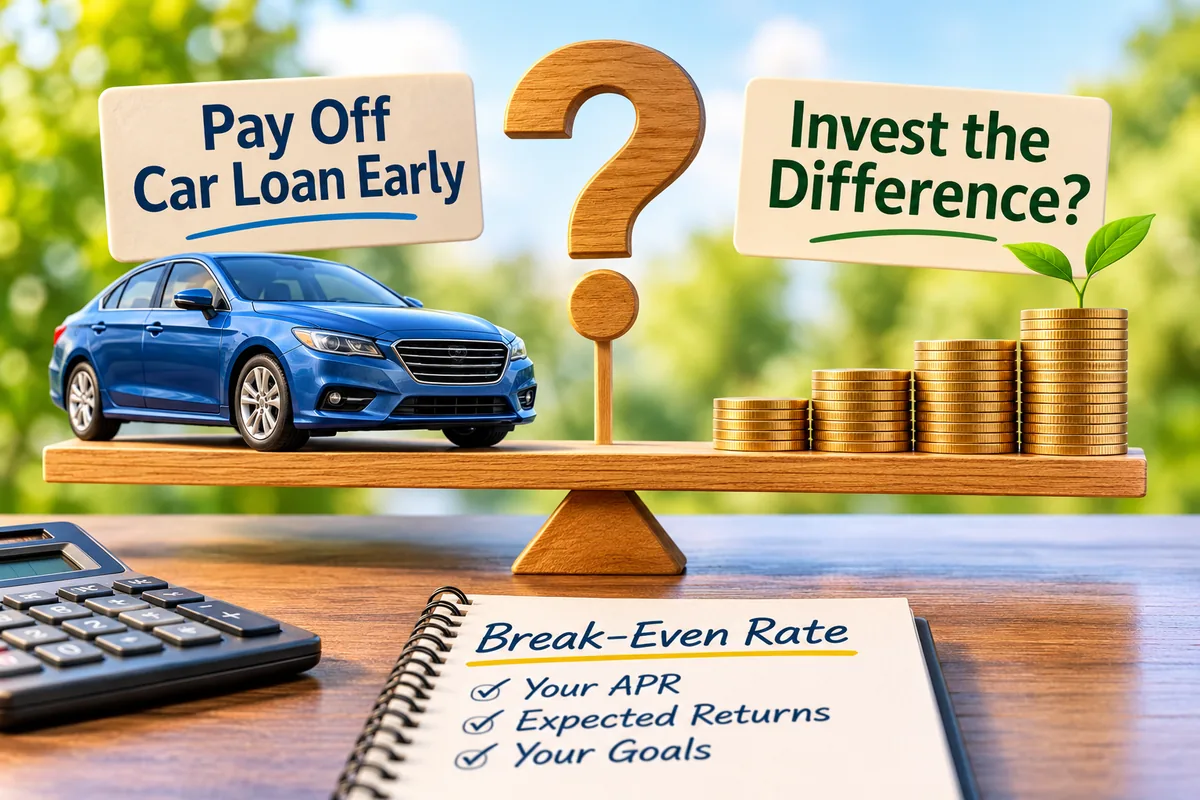
Should you pay off your car loan early or invest the extra cash? Compare your loan's APR to the after-tax return you can realistically expect. If the APR is higher, pay the loan down. If it is clearly lower, invest. That crossover point is your break-even rate, and for many borrowers it lands close enough to the middle that your comfort with risk breaks the tie.
Here is the math, with one worked example, so you can run it on your own loan in about five minutes.
Step 1: Find your break-even rate (it's your APR)
Your car loan's APR is a guaranteed return. Every extra dollar you put toward the balance "earns" that rate, because it is interest you will never pay. So the break-even rate is simply your APR: investing only wins if you expect to earn more than that, after taxes and after allowing for the fact that markets come with no guarantee.
Your APR depends mostly on your credit. According to Experian's Q2 2026 data, the average new-car APR runs from 4.41% for super-prime borrowers (VantageScore 781+) to 6.15% for prime, 9.71% for near-prime and 13.52% for subprime. Edmunds reports the overall new-car average was 7% in Q3 2026.
Here is a rule of thumb. It is my own shorthand, not a law:
- Below about 5%: investing usually has the edge, especially in a 401(k) with a match or a Roth IRA.
- About 5% to 8%: the gray zone. Split the extra cash between the loan and investments.
- Above about 8%: prepay. A guaranteed 8% or more is hard to beat.
To run this on your own loan, pull three numbers from your lender's app or your latest statement: the remaining balance, the APR and the months left. Then ask whether you would confidently expect to beat that APR after taxes, with money you will not need for years. If the answer is a shaky "maybe," the loan is probably the better home for the cash.
A worked example: $30,000 left at 7%
Say you owe $30,000 at 7% APR with 48 months to go, so the required payment is $718.39. You find an extra $500 a month. You have two plans:
- Plan A, prepay: pay $1,218 a month ($718 plus $500) until the loan is gone in month 27, then invest the full $1,218 a month through month 48.
- Plan B, invest: pay the $718 minimum and invest $500 a month for all 48 months.
Plan A pays about $2,500 in total interest. Plan B pays about $4,500, so prepaying saves roughly $2,000. The question is whether Plan B's investing earns that back. Here is each plan's net position (investments minus loan balance) at month 48 under three steady annual returns:
| Assumed return | Plan A: prepay | Plan B: invest | Result |
|---|---|---|---|
| 4% | about $26,900 | about $26,000 | Prepay wins by about $920 |
| 7% | about $27,600 | about $27,600 | Tie (break-even) |
| 10% | about $28,300 | about $29,400 | Invest wins by about $1,030 |
The tie lands at exactly 7%, the loan's APR. That is the break-even rate at work. This is a simplified, hypothetical model: steady returns, no taxes or fees, contributions at the end of each month. Real markets do not deliver anything steady.

Rally's take
I bury bones for later. Most of the time it pays off, but I have definitely dug up an empty hole. Paying off a 7% loan is the bone that comes back every single time. Guaranteed is not glamorous. It is just guaranteed.
Why it's not a fair fight: guaranteed vs. expected
The 10% row looks tempting. NerdWallet's analysis of S&P 500 data from 1926 through 2025 puts the long-run average near 10% a year, but annual returns landed in the 8% to 12% band in only eight of those years, and the index was positive in about 70% of them. NerdWallet itself uses 6% as a planning assumption.
A paid-off 7% loan is a sure 7%. A stock fund is an expected 6% to 10% with years that lose money, plus taxes on gains in a regular brokerage account. That gap is why you want a cushion above your APR before you take on the risk, and why a 401(k) or Roth IRA, where gains are sheltered, makes investing a better bet.
One thing tilts the math the other way. If you bought a new, U.S.-assembled car, your interest may be deductible, which lowers the loan's real cost. Our car loan interest deduction guide covers who qualifies.
Do these four things before either one
The car-loan-versus-investing question only matters once the basics are covered. In order:
- Capture the full 401(k) match. An instant match beats any loan payoff. If you are unsure how to split retirement dollars, see our Roth IRA vs. 401(k) guide.
- Build your emergency fund. Aim for three to six months of essentials, parked in a high-yield savings account such as Ally.
- Pay off higher-APR debt first. A credit card balance usually costs far more than a car loan. Our avalanche vs. snowball comparison shows how to order the payoff.
- Use an HSA if you are eligible. It is one of the few accounts with a tax break going in, growing, and coming out.
How to pay off a car loan early without getting burned
If your numbers say prepay, or the gray zone says split, set it up carefully:
- Check your interest type. The CFPB says most auto loans use simple interest, where extra payments shrink the principal and the interest that accrues on it. With precomputed interest, extra payments do not reduce the interest owed, though you may get a partial refund of unearned interest.
- Read the contract for prepayment fees. Some lenders charge for early payoff, so confirm before you send a big payment.
- Ask how extra payments are applied. Tell your lender to put the extra toward principal, then check the next statement.
- Split the difference in the gray zone. Sending half the extra cash to the loan and half to investments gives you a guaranteed win and a market upside.
- Do not drain your emergency fund to speed up the payoff. Cash on hand is worth more than a lower balance if your car or your job gets expensive.
The bottom line: your APR is the number to beat. Below about 5%, invest after the basics. Above about 8%, pay the loan down. In between, split the cash and sleep well. Whichever way you go, the real win is deciding on purpose, with your own numbers, instead of drifting along on autopay.
Frequently asked questions
Does paying off a car loan early hurt my credit score?
It can cause a small, temporary dip, because an open account in good standing closes. For most people the effect is minor and not a good reason to keep paying 7% interest. If you plan to apply for a mortgage soon, ask your lender whether the timing matters.
Should I refinance instead of paying off my car loan early?
If your credit has improved or rates have dropped since you took the loan, refinancing to a lower APR also lowers your break-even rate. Compare total interest and any fees, not just the monthly payment, and avoid stretching the term. If a better rate is not available, prepaying is the simpler route.
Does the car loan interest deduction change the math?
Yes, if you qualify. The deduction applies to interest on a new, U.S.-assembled car, so it lowers what the loan effectively costs you and pushes the break-even rate down. For a borrower in the 22% bracket taking the full deduction, a 7% loan costs roughly 5.5% after tax.
Is it worth paying off a 0% or very low-APR car loan early?
Usually not. At 0%, extra payments earn nothing, so the money does more work in your emergency fund, your 401(k) match, or an index fund. At rates well below 5%, the same logic applies as long as you can stomach market ups and downs.
Sources: Edmunds Q3 2026 data via KPRC Click2Houston (Oct. 2026); Experian average car loan rates by credit score (Q2 2026); NerdWallet: average stock market return (updated March 2026); CFPB: extra payments on a car loan; Experian: does paying off a car loan early hurt your credit?; IRS: car loan interest deduction. Figures as of October 2026; rates change. The worked example is hypothetical, not a recommendation.